


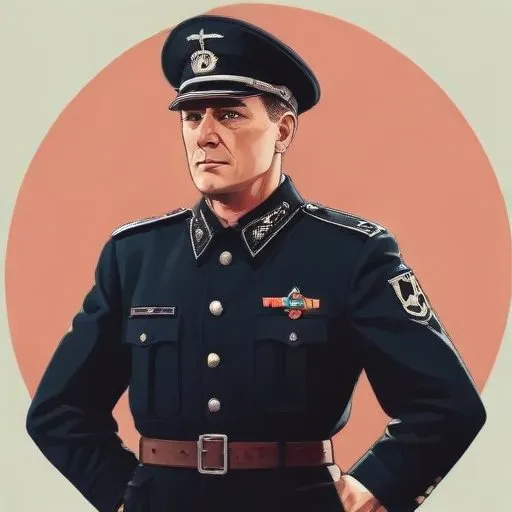
High-ranking SS officer responsible for overseeing the administration of concentration camps during World War II, implementing brutal policies and overseeing mass atrocities.
Richard Glücks, a high-ranking German SS functionary, is infamous for commanding the Concentration Camps Inspectorate during the Nazi era, overseeing the forced labor of camp inmates and implementing the brutal Final Solution. As a direct subordinate of Heinrich Himmler, Glücks played a pivotal role in the mass murder of inmates using Zyklon B gas.
Glücks was born on April 22, 1889, in Odenkirchen, Rhineland, Germany. He completed his education at a gymnasium in Düsseldorf and later worked in his father's fire insurance agency. In 1909, Glücks joined the army as a volunteer, serving in the artillery for a year. He then moved to England and later to Argentina, where he worked as a trader.
When World War I broke out, Glücks returned to Germany under a false identity and rejoined the army. During the war, he rose to become the commander of an artillery unit and was awarded the Iron Cross I and II. He fought in the Battle of Verdun and the Battle of the Somme.
After the war, Glücks became a liaison officer between the German forces and the Military Inter-Allied Commission of Control. He remained in this position until 1924 and later joined the staff of the 6th Prussian Division. Glücks also served in the Freikorps, a paramilitary organization.
In 1930, Glücks joined the NSDAP (Nazi Party) and two years later, the SS (Schutzstaffel). His rapid rise through the ranks was marked by his appointment as the commander of the Concentration Camps Inspectorate in November 1939.
As the commander of the Concentration Camps Inspectorate, Glücks was responsible for the administration of the camps, including the forced labor of inmates and the implementation of medical experiments. He was also involved in the planning and execution of the Final Solution, the mass murder of Jewish people and other persecuted groups using Zyklon B gas.
Glücks reported directly to Heinrich Himmler and was known for his brutal efficiency in carrying out the Nazi regime's policies. He was the supervisor of the medical practices in the camps, which included human experimentation and the testing of new medical procedures on inmates.
After Germany's defeat in World War II, Glücks committed suicide on May 10, 1945, by swallowing a potassium cyanide capsule. His legacy is one of brutality and genocide, and his actions during the Nazi era continue to haunt humanity.
Glücks' story serves as a reminder of the dangers of unchecked power and the devastating consequences of prejudice and hatred. His role in the Nazi regime's atrocities serves as a warning to future generations, highlighting the importance of protecting human rights and preventing such horrors from happening again.
Born in 1900
Leading the SS and Gestapo, he oversaw the Nazi regime's brutal security apparatus and implemented the "Final Solution," orchestrating the genocide of six million Jews during World War II.
Born in 1889
The dictator of Nazi Germany, responsible for the genocide of six million Jews and millions of other people during World War II, and infamous for his extreme nationalist and anti-Semitic ideology.
Born in 1904
A high-ranking Nazi official and chief architect of the Holocaust, responsible for implementing the "Final Solution" that led to the murder of six million Jews and millions of others during World War II.
Born in 1903
Austrian-German lawyer and general who served as the highest-ranking leader of the Nazi police forces, responsible for overseeing the Gestapo, SS, and concentration camps during World War II. He was a key figure in the Holocaust and other atrocities committed by the Nazi regime.
Born in 1892
A ruthless and efficient administrator who oversaw the creation and operation of Nazi concentration camps during World War II, responsible for the deaths of millions of people.
Born in 1900
Commandant of Auschwitz concentration camp during WWII, responsible for the murder of over a million people, particularly Jews, during the Holocaust.
Born in 1904
A high-ranking Nazi officer and physician who oversaw the Nazi euthanasia program, responsible for the deaths of thousands of people with mental and physical disabilities.
Born in 1849
A pioneer in geometry and group theory, known for developing the Erlangen program, which unified various geometries under a single framework. His work laid foundations for modern algebraic geometry and topology.
