


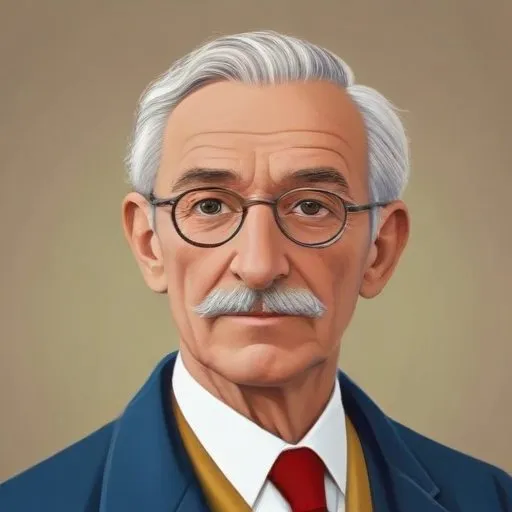
A Czech-Austrian botanist and academic who pioneered the field of plant physiology, making significant contributions to the understanding of photosynthesis and plant growth. His work laid the foundation for modern plant biology.
Hans Molisch, a renowned Czech-Austrian botanist, made significant contributions to the field of botany, earning him a lasting legacy. His groundbreaking work led to the development of the Molisch test, a sensitive chemical test for the presence of carbohydrates, which remains a crucial tool in scientific research to this day.
Hans Molisch was born on December 6, 1856, in Brno, Habsburg Moravia (now the Czech Republic). Little is known about his early life, but his academic pursuits led him to become a prominent figure in the scientific community.
Molisch's illustrious academic career spanned over four decades, during which he taught at prestigious institutions, including the German University of Prague, Vienna University, Tohoku Imperial University in Japan, and the Bose Institute in Kolkata, India. His research focus on botany led to the publication of numerous literary works, including "Die Pflanzen in ihren Beziehungen zum Eisen" (1892), "Leuchtende Pflanzen" (1904), and "Pflanzenphysiologie" (1920).
During his tenure as rector of the University of Vienna (1926-1927), Molisch faced criticism for his alleged role in promoting anti-Semitic and pro-German nationalist sentiment among students. His leniency in punishing perpetrators of violence against Jewish students and political dissenters raised concerns about his leadership.
Molisch's written works not only showcased his scientific expertise but also highlighted his fascination with the natural world. His travelogue, "Im Lande der aufgehenden Sonne" (1927), offers a glimpse into his experiences in Japan.
In recognition of his contributions, Molisch served as the vice-president of the Austrian Academy of Sciences from 1931 to 1937.
Hans Molisch passed away on December 8, 1937, in Vienna, Austria, leaving behind a rich legacy in the world of botany.
Through his groundbreaking research, literary works, and academic contributions, Hans Molisch has left an indelible mark on the scientific community. His pioneering work in carbohydrate detection and plant physiology continues to inspire new generations of scientists and researchers.
Born in 1822
An Austrian monk who pioneered genetics by experimenting with pea plants, discovering the fundamental laws of heredity, and laying the foundation for modern genetics.
Born in 1809
Developed the theory of evolution through natural selection, revolutionizing our understanding of life on Earth. This groundbreaking idea transformed the fields of biology, ecology, and beyond.
Born in 1744
A French soldier, biologist, and academic who developed a theory of inheritance of acquired characteristics, proposing that organisms adapt to their environment and pass on those traits to their offspring.
Born in 1800
German chemist and academic who synthesized urea, debunking the theory of vitalism, and made significant contributions to organic chemistry. He is considered one of the founders of modern organic chemistry.
Born in 1803
Developed groundbreaking theories on organic chemistry and agriculture, revolutionizing farming practices and earning the title "Father of Fertilizers".
Born in 1810
Discovered the Schwann cells, a type of cell that provides support to neurons in the peripheral nervous system, and formulated the theory of cellular structure, which states that all living organisms are composed of cells.
Born in 1804
A German botanist who, along with Theodor Schwann, formulated the cell theory, which states that all living organisms are composed of cells and that cells are the basic units of life.
Born in 1821
A pioneer in modern medicine, he founded the field of social medicine, emphasizing the importance of social and environmental factors on health, and made significant contributions to cellular pathology.
