


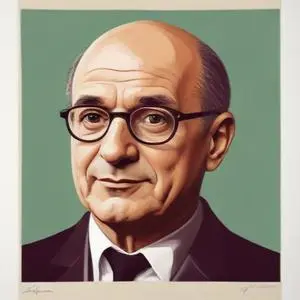
A German embryologist and academic who discovered the organizer effect, a fundamental concept in developmental biology, and was awarded the Nobel Prize in Physiology or Medicine in 1935.
German embryologist Hans Spemann is renowned for his groundbreaking discovery of embryonic induction, a phenomenon where various parts of an embryo influence the development of cells into specific tissues and organs. This concept, which earned him the Nobel Prize in Physiology or Medicine in 1935, revolutionized the field of embryology and shed light on the complexities of developmental biology.
Born on June 27, 1869, in Stuttgart, Germany, Spemann was the eldest son of publisher Wilhelm Spemann and his wife Lisinka. After completing his schooling in 1888, he spent a year in his father's business before serving in the Kassel Hussars and later working as a bookseller in Hamburg.
In 1891, Spemann enrolled at the University of Heidelberg, where he studied medicine and met the biologist and psychologist Gustav Wolff. It was during this period that Wolff's experiments on the embryological development of newts sparked Spemann's interest in the field.
Spemann's academic journey took him to the University of Munich, where he received his clinical training from 1893 to 1894. However, he soon realized that his true calling lay in research and not clinical practice. He moved to the Zoological Institute at the University of Würzburg, where he remained as a lecturer until 1908.
During his time at Würzburg, Spemann worked under the guidance of esteemed scientists such as Theodor Boveri, Julius von Sachs, and Wilhelm Röntgen. He earned his Ph.D. in 1895, with a thesis on cell lineage in the parasitic worm Strongylus paradoxus. His teaching diploma focused on the development of the middle ear in frogs.
Spemann's most significant contribution to science came in the form of his work on embryonic induction. In his research, he demonstrated that various parts of an embryo could influence the development of cells into specific tissues and organs. This concept challenged the prevailing views of developmental biology and paved the way for further research in the field.
Spemann's student, Hilde Mangold, played a crucial role in this discovery. Her work on newt embryos led to the identification of the organizer effect, a phenomenon where a specific group of cells could induce the formation of an entire embryo. Spemann added his name as an author to Mangold's dissertation, despite her objections, and later received the Nobel Prize for their combined work.
Hans Spemann's work on embryonic induction has had a profound impact on our understanding of developmental biology. His holistic approach to biology has inspired generations of scientists, and his discovery continues to influence research in the fields of embryology, genetics, and tissue engineering.
Spemann's legacy extends beyond his scientific contributions. He was a devoted family man, married to Klara Binder, with whom he had four children. His commitment to his family and his passion for science serve as an inspiration to aspiring researchers and scientists.
"The embryo is a mosaic of inductions."
- Hans Spemann
Hans Spemann's remarkable journey has left an indelible mark on the world of science. His groundbreaking discovery of embryonic induction continues to shape our understanding of developmental biology, inspiring new generations of researchers to explore the wonders of life.
Born in 1821
A pioneer in modern medicine, he founded the field of social medicine, emphasizing the importance of social and environmental factors on health, and made significant contributions to cellular pathology.
Born in 1857
A pioneer in the field of electromagnetism, he discovered radio waves and proved James Clerk Maxwell's theories, paving the way for modern wireless communication. His experiments led to the development of radio, television, and mobile phones.
Born in 1834
A German biologist, physician, and philosopher who coined the term "ecology" and made significant contributions to the field of evolutionary biology, including the recapitulation theory.
Born in 1800
German chemist and academic who synthesized urea, debunking the theory of vitalism, and made significant contributions to organic chemistry. He is considered one of the founders of modern organic chemistry.
Born in 1881
Developed groundbreaking theories on polymers, revolutionizing the field of organic chemistry, and was awarded the Nobel Prize in Chemistry in 1953.
