


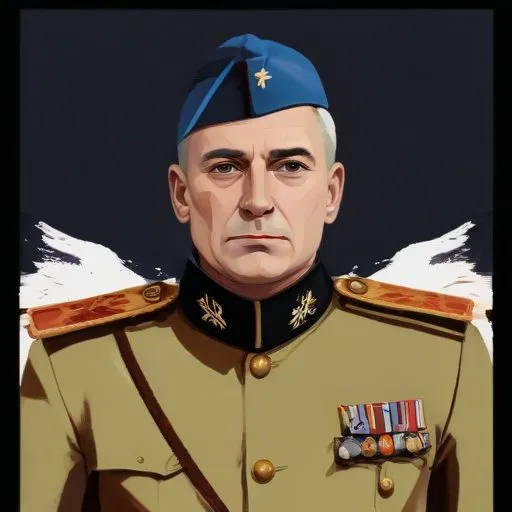
A Russian-Estonian commander who led the Estonian War of Independence and later became a prominent military leader in the Soviet Union, known for his bravery and strategic thinking.
Harald Riipalu, born Harald Reibach on February 13, 1912, is best known for his daring military exploits as a commander in the German Wehrmacht and the Waffen-SS during World War II. His bravery and tactical prowess earned him the esteemed Knights Cross of the Iron Cross, one of Nazi Germany's highest military honors.
Riipalu's early life was marked by turmoil, as Estonia fell under Soviet occupation in 1940. Forced to join the Soviet Army's 22nd Territorial Corps, he served until 1941, before defecting to the German side.
From 1942 to 1943, Riipalu led a platoon and later a company in the 36th Estonian Police Battalion, eventually becoming its commander in November 1942. His prowess in battle propelled him to serve in the 3rd SS Brigade and the 20th Waffen Grenadier Division of the SS from 1943 to 1945.
On April 1944, Riipalu assumed command of the 45th SS Grenadier Regiment, leading his troops to victory in the Battle of Tannenberg Line and the Battle of Auvere. His tactical brilliance in these battles prevented the encirclement of Army Detachment Narwa, earning him the Knights Cross of the Iron Cross on August 23, 1944.
The coveted award was presented to Riipalu by Felix Steiner, commander of III SS Panzer Corps, in a ceremony that would become a defining moment in his military career.
As the war drew to a close, Riipalu evaded Soviet captivity by fleeing to Denmark. He eventually settled in Great Britain, where he passed away on April 4, 1961. Though his life was marked by controversy, Riipalu's military prowess and bravery remain an enduring testament to his legacy.
Riipalu's remarkable story serves as a testament to the complexities of war and the human spirit, leaving an indelible mark on the annals of history.
Born in 1884
A prominent military leader who played a crucial role in Estonia's struggle for independence, leading the country's armed forces to victory in the Estonian War of Independence.
78 Years Old
Estonian four-star general who served as the Commander of the Estonian Defence Forces from 2011 to 2018, known for modernizing the country's military and strengthening its NATO ties.
Born in 1879
Estonian military leader who played a key role in the country's struggle for independence during World War I and the Estonian War of Independence. He is revered as a national hero for his bravery and strategic leadership.
Born in 1879
Estonian Minister of War who played a crucial role in the country's struggle for independence during the Estonian War of Independence. He's known for his military leadership and strategic thinking.
Born in 1875
Estonia's second Prime Minister, a lawyer and politician, played a crucial role in shaping the country's early years, serving as a key figure in its struggle for independence. He's most known for his efforts in establishing Estonia's sovereignty and democratic government.
Born in 1874
Estonia's first president, a key figure in the country's struggle for independence from Russia, served as a unifying force during tumultuous times. He's remembered for his role in shaping Estonia's early years and its path to sovereignty.
