


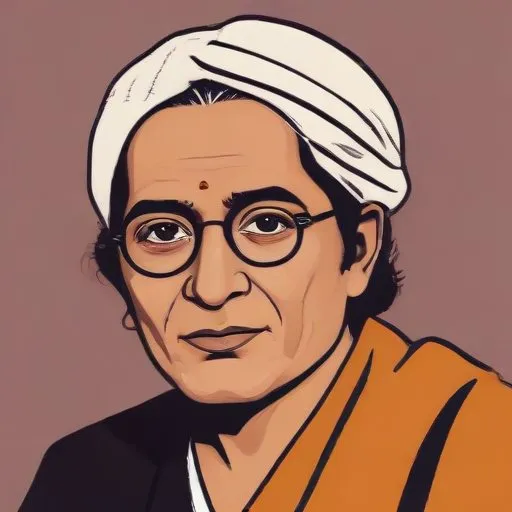
A multifaceted Indian figure who excelled as a poet, actor, and politician, leaving a mark on the country's cultural and political landscape. Known for his contributions to Bengali literature and his role in India's struggle for independence.
Harindranath Chattopadhyay was a towering figure in Indian literature, known for his extraordinary contributions as a poet, dramatist, actor, musician, and politician. He was a member of the 1st Lok Sabha from Vijayawada constituency and the younger brother of Sarojini Naidu, the second woman President of the Indian National Congress.
Born on April 2, 1898, in Hyderabad State, Harindranath was the son of Aghorenath Chattopadhyay, a Doctorate of Science from the University of Edinburgh, and Baradasundari Chattopadhyay, a poet who wrote in Bengali. His father founded and administered the Hyderabad College, which later became the Nizams College in Hyderabad.
Harindranath's love for poetry and music was evident from a young age. His first book of poems, The Feast of Youth, was published when he was just 19 years old and received praise from notable literary figures like Arthur Quiller-Couch and James Henry Cousins.
Harindranath's poetry was deeply rooted in ancient Indian culture and Vedic ideas. He wrote in English, exploring themes that resonated with the Indian psyche. His poems, such as "Noon" and "Shaper Shaped", showcased his mastery of language and his ability to weave together mythology, history, and philosophy.
In addition to his literary pursuits, Harindranath was an active participant in Indian politics. He was a member of the 1st Lok Sabha from Vijayawada constituency and worked tirelessly to promote Indian arts and culture.
In 1973, the Government of India awarded him the Padma Bhushan, one of the highest civilian honors, in recognition of his contributions to literature and public service.
Harindranath married Kamaladevi Chattopadhyaya, a Socialist leader and champion of women's rights. The couple had two sons, but their marriage ended in divorce, marking the first legal separation granted by the courts of India. Despite the divorce, the couple remained on amicable terms.
Harindranath's legacy extends far beyond his literary works. He was a pioneer in promoting Indian arts and culture, and his contributions to the world of music, theatre, and cinema are still remembered today.
His poem "Rail Gaadi" was memorably sung by Ashok Kumar in the film Aashirwad, showcasing Harindranath's talent for composing music and writing lyrics.
Today, Harindranath Chattopadhyay is remembered as a multifaceted Indian literary giant, whose contributions to literature, music, and public life continue to inspire generations.
Harindranath Chattopadhyay's remarkable life and achievements serve as a testament to his unwavering passion for art, literature, and public service. His legacy continues to inspire Indians and people around the world, ensuring his place as one of India's most revered literary figures.
Born in 1861
A Bengali polymath who wrote extensively on love, nature, and humanity, creating a unique blend of Indian and Western literary styles, and was the first non-European to win the Nobel Prize in Literature.
Born in 1879
A pioneering Indian poet and activist who used her lyrical voice to advocate for women's rights and Indian independence, leaving a lasting legacy in Indian literature and politics.
Born in 1869
Indian freedom fighter, activist, and philosopher who led India to independence from British rule through non-violent civil disobedience, inspiring civil rights movements worldwide.
Born in 1889
India's first Prime Minister, a key figure in the country's struggle for independence from British rule, and a champion of democracy and secularism. He played a crucial role in shaping modern India's government and economy.
Born in 1897
Indian freedom fighter and politician who led the Indian National Army against British rule and was a key figure in the country's struggle for independence. He is also known for his mysterious disappearance in 1945.
Born in 1878
The first Indian Governor-General of India, serving from 1948 to 1950, and a key figure in the country's struggle for independence from British rule. He was a strong advocate for non-violent resistance and played a crucial role in shaping India's early years.
Born in 1887
Founder of Bharatiya Vidya Bhavan, a renowned Indian educational institution, and a multifaceted personality who made significant contributions to literature, politics, and education.
Born in 1884
India's first president, a key figure in the country's struggle for independence, who played a crucial role in shaping the nation's early years. He's revered for his leadership and commitment to democracy.
