


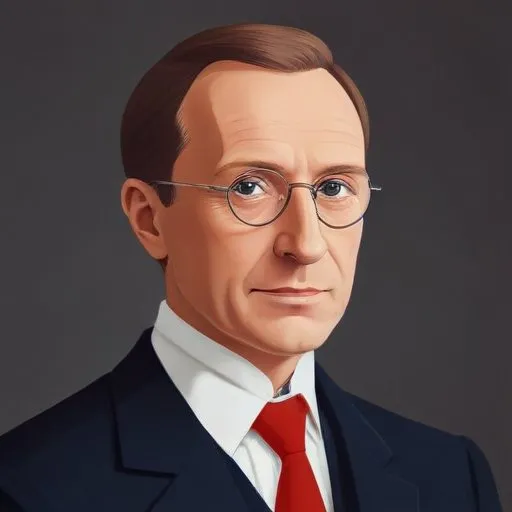
A pioneer in the field of meteorology, he discovered the principle of thermal convection and developed the first anemometer to measure wind speed. His work laid the foundation for modern weather forecasting.
Heinrich Wilhelm Dove was a renowned Prussian physicist and meteorologist who left an indelible mark on the scientific community through his groundbreaking research and innovative discoveries. He is best known for his contributions to the fields of climatology, meteorology, and experimental physics, particularly his observation of the rotation of tropical cyclones and the discovery of binaural beats.
Dove was born on October 6, 1803, in Liegnitz, Kingdom of Prussia, to a family of modest means. Despite the financial constraints, his parents encouraged his love for learning, and he went on to study history, philosophy, and natural sciences at the University of Breslau from 1821 to 1824. He then continued his education at the University of Berlin, graduating in 1826.
Dove's academic career was marked by rapid progression, and he became a Privatdozent at the University of Königsberg in 1826 and a Professor extraordinarius in 1828. In 1845, he was appointed Professor ordinarius at the Friedrich-Wilhelms-Universität in Berlin, where he served as rector twice, from 1858 to 1859 and again from 1871 to 1872.
Dove's most significant contributions were in the fields of meteorology and experimental physics. He published over 300 papers, many of which dealt with experimental physics. His work on climatology, pioneered by Alexander von Humboldt, led to significant advances in the field.
In 1828, Dove made a crucial observation that tropical cyclones rotate counterclockwise in the Northern Hemisphere but clockwise in the Southern Hemisphere. This discovery revolutionized the understanding of weather patterns and paved the way for future research in meteorology.
In 1839, Dove discovered the technique of binaural beats, where slightly different frequencies played separately to each ear produce a perception of interference beats at the same rate as would be physically created. This discovery has since been applied in various fields, including psychology and music therapy.
In 1841, Dove invented the differential inductor, a device that demonstrated the principle of electromagnetic induction. This invention was a significant milestone in the development of electrical engineering.
In 1849, Dove became the director of the Prussian Meteorological Institute, a position he held until his death on April 4, 1879. Throughout his career, Dove received numerous honors and awards for his contributions to science, including being elected as a member of the Royal Swedish Academy of Sciences.
Dove's legacy extends far beyond his own lifetime. His work in meteorology and experimental physics laid the foundation for future generations of scientists. His discoveries and inventions continue to inspire and influence researchers today, making him one of the most important figures in the history of science.
Born in 1821
A 19th-century physician and physicist who made significant contributions to the fields of electromagnetism, thermodynamics, and the physiology of human perception, particularly in the study of vision and hearing.
Born in 1822
Developed the theory of thermodynamics, introducing the concept of entropy, and made significant contributions to the fields of electricity and magnetism.
Born in 1831
Developed groundbreaking theories that unified electricity and magnetism, and predicted the existence of radio waves, revolutionizing our understanding of the physical world.
Born in 1844
Developed the theory of statistical mechanics, which explains the behavior of gases and is a fundamental concept in modern physics.
Born in 1824
Developed fundamental laws of thermodynamics and electromagnetism, shaping our understanding of energy and its interactions.
Born in 1775
A pioneer in the field of electromagnetism, he formulated fundamental laws that describe the relationship between electric currents and magnetic fields. His work laid the foundation for many modern technologies, including electric motors and generators.
Born in 1791
Pioneering scientist who discovered electromagnetic induction, formulated the laws of electrolysis, and invented the first electrical generator, revolutionizing our understanding of electricity and its applications.
Born in 1743
Father of modern chemistry, discovered oxygen, and developed a systematic method of chemical nomenclature. He laid the foundation for modern chemistry and paved the way for future scientific discoveries.
