


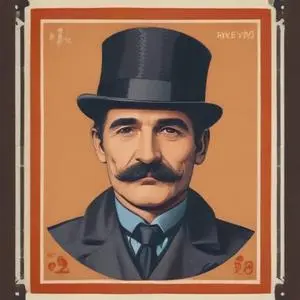
Founded the Universal Postal Union, revolutionizing global mail exchange and standardizing postal rates, making international communication faster and more efficient.
Stephan was born on January 7, 1831, in Stolp, Pomerania, in the Kingdom of Prussia. He began his career as a local postal clerk in the service of the Prussian post in 1849. Stephan's dedication and perseverance soon earned him recognition, and in 1866, he was put in charge by the Prussian government of federalizing the postal service, which had long been privately run by the noble Thurn und Taxis family.
In 1870, Stephan was named director of postal services for the North German Confederation, marking the beginning of a swift ascent up the ranks. He was subsequently appointed Postmaster General of the German Empire in 1876, Undersecretary of State in charge of the post office in 1880, and Minister of Postal Services for Germany in 1895.
Stephan's most significant contributions were the standardization of postal services and the introduction of new postal products. He worked tirelessly to establish a uniform postage rate throughout Germany, facilitating easier mailing and communication. In 1871, he introduced the postcard, which had initially been suggested in 1865, and it soon became a popular method of communication during the Franco-Prussian War.
Additionally, Stephan played a crucial role in introducing the telephone to Germany in 1877. His efforts to combine the postal service with the telegraph service in Germany were instrumental in laying the groundwork for modern-day telecommunications.
In 1874, Stephan organized the International Postal Conference in Bern, which led to the establishment of the Universal Postal Union (UPU). The UPU aimed to standardize postal services worldwide, ensuring uniform rates, formats, and procedures across member countries. Stephan's vision for a unified global postal system has had a profound impact on international communication and commerce.
Stephan's contributions to the development of modern postal services have been immense. He died on April 8, 1897, in Berlin, leaving behind a legacy that has shaped the course of global communication. His emphasis on standardization, internationalization, and innovation has inspired generations of postal administrators and policymakers.
Stephan's remarkable achievements were recognized during his lifetime. He received numerous awards and honors, including the title of Minister of Postal Services, which was conferred upon him in 1895.
Throughout his life, Stephan remained committed to his work, and his personal milestones were often intertwined with his professional achievements. His appointment as Postmaster General of the German Empire in 1876 marked a significant turning point in his career.
Stephan's work took place during a time of significant social, economic, and political change in Germany. The country was transitioning from a collection of independent states to a unified nation, and Stephan's efforts to standardize and modernize postal services played a crucial role in this process.
Stephan's contributions to the development of modern postal services can be compared to those of other pioneers in the field, such as Rowland Hill, who introduced the penny post in the United Kingdom. While both individuals shared a vision for affordable and efficient postal services, Stephan's emphasis on internationalization and standardization set him apart.
Heinrich von Stephan was a true visionary, whose tireless efforts to modernize and standardize postal services have had a lasting impact on global communication. His legacy continues to inspire generations, and his contributions to the development of modern postal services remain unparalleled.
Born in 1815
Unified Germany's founder, a master strategist who forged a nation through diplomacy and war, leaving a lasting legacy in European politics.
Born in 1820
A 19th-century philosopher and economist who co-authored "The Communist Manifesto" with Karl Marx, shaping modern socialist and communist thought. He also wrote extensively on economics, history, and politics.
Born in 1818
A 19th-century philosopher who developed the theory of communism, arguing that capitalism would eventually be replaced by a socialist society. He's known for his critique of capitalism and the concept of class struggle.
Born in 1805
A French diplomat and engineer who developed the Suez Canal, a crucial waterway connecting the Mediterranean Sea to the Red Sea, revolutionizing global trade and commerce.
Born in 1769
A French military leader who rose to prominence during the French Revolution and became Emperor of France, known for his military conquests and reorganization of Europe. He is also famous for his Napoleonic Code, which remains a foundation of modern law.
Born in 1819
The monarch who ruled the British Empire for 63 years, overseeing the Industrial Revolution and expanding the empire's reach, earning the nickname "the Grandmother of Europe".
Born in 1820
Pioneering nurse and statistician who revolutionized healthcare by introducing sanitation practices and data-driven decision making, becoming the founder of modern nursing.
