


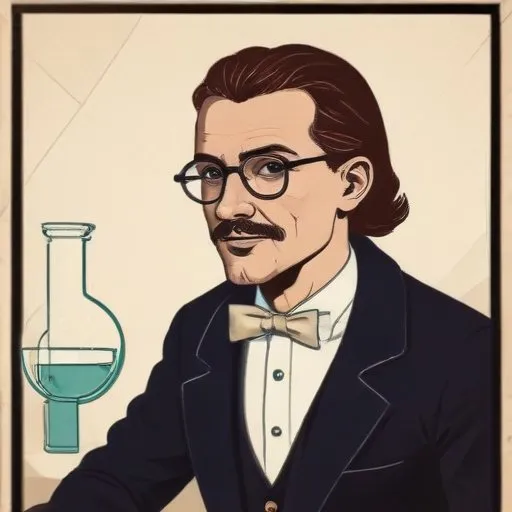
A Dutch chemist and academic who pioneered the field of physical chemistry, particularly in the study of phase equilibria and heterogeneous equilibria.
Hendrik Willem Bakhuis Roozeboom was a Dutch chemist who made groundbreaking contributions to the field of physical chemistry, particularly in the study of phase behaviour and thermodynamics. He is renowned for his work on phase equilibria, which laid the foundation for understanding complex chemical reactions and has had a lasting impact on the development of metallurgy.
Born on October 24, 1854, in Alkmaar, Netherlands, Roozeboom faced financial difficulties that hindered his ability to pursue a university education directly. Instead, he worked in a chemical factory for a period before becoming an assistant at the University of Leiden in 1878, thanks to the support of his mentor, J. M. van Bemmelen. This opportunity enabled him to start his academic education, and he went on to obtain his PhD in 1884 with works on the hydrates of acids.
Roozeboom's interest in phase behaviour was sparked by the theoretical works of J. Willard Gibbs on the phase rule, which had little experimental verification in chemistry at the time. This led him to initiate a lifelong research program on phase equilibria. In 1896, he became a professor of chemistry at the University of Amsterdam, where he continued to dedicate himself to his research.
Development of Melting Phase Diagrams: Roozeboom created the first melting phase diagrams of metal alloys, which are crucial for understanding the behavior of mixtures of metals during the melting process. This work has had a significant impact on the field of metallurgy.
Innovative Visualization Techniques: He introduced the concept of plotting ternary phase equilibria in two-dimensional plots, taken as vertical or horizontal slices from three-dimensional solid diagrams. These plots, known as isopleths and isotherms, have become essential tools in the study of phase behaviour.
Advancements in Chiral Substances: Roozeboom made significant contributions to the science of chiral substances, clarifying how to distinguish different types of crystalline racemates and predicting their properties.
Roozeboom's pioneering work in phase behaviour and thermodynamics has had a lasting impact on the development of physical chemistry. His research has influenced numerous fields, including metallurgy, materials science, and chemical engineering. Today, his work remains a cornerstone of modern chemistry, continuing to inspire new generations of scientists and researchers.
Roozeboom's life was marked by his dedication to his research and his passion for chemistry. Despite facing financial difficulties early in his life, he persevered and went on to achieve great success in his field. He passed away on February 8, 1907, leaving behind a legacy that continues to shape the world of chemistry.
Born in 1852
Pioneering chemist who discovered the laws of chemical equilibrium and osmotic pressure, revolutionizing our understanding of chemical reactions.
Born in 1859
A Nobel Prize-winning physicist and chemist who pioneered the understanding of acid-base chemistry and greenhouse gases, laying the foundation for modern climate science.
Born in 1853
A Latvian-German chemist and academic who pioneered work on catalysis, chemical equilibria, and reaction rates, earning a Nobel Prize in Chemistry in 1909. He's also credited with developing the Ostwald process for producing nitric acid.
Born in 1852
A German chemist and academic who won the Nobel Prize for synthesizing amino acids and sugars, and establishing the structure of purines, revolutionizing the field of organic chemistry.
Born in 1860
A pioneer in biochemistry, he discovered that yeast extracts can ferment sugar without living yeast cells, laying the foundation for modern industrial fermentation processes. His work revolutionized the production of beer, wine, and bread.
Born in 1871
A pioneer in nuclear physics, he discovered the nucleus of an atom and developed the Rutherford model, revolutionizing our understanding of the atomic structure.
Born in 1867
A pioneering scientist who pioneered radioactivity research, discovering elements polonium and radium, and paving the way for breakthroughs in medicine and energy.
Born in 1859
A pioneer in radioactivity research, discovering elements like polonium and radium, and pioneering radioactive isolation techniques. Their groundbreaking work paved the way for advancements in medicine, energy, and materials science.
