


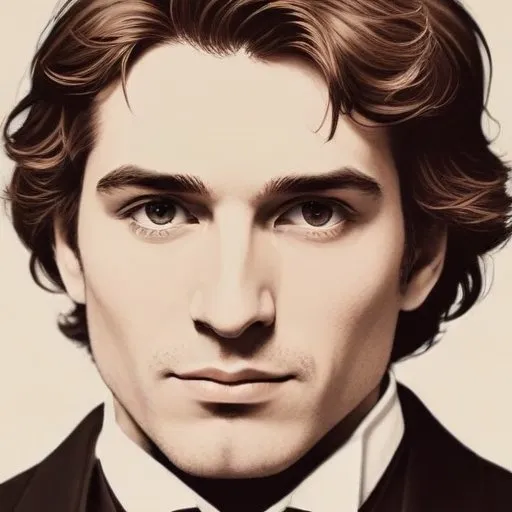
A French painter and lithographer renowned for his dreamy, atmospheric still-life compositions and portraits of Parisian intellectuals, capturing the essence of 19th-century French art and culture.
Henri Fantin-Latour, a French painter and lithographer, is renowned for his exquisite flower paintings and group portraits of Parisian artists and writers. Born on January 14, 1836, in Grenoble, Isère, Fantin-Latour's artistic career spanned over five decades, leaving an indelible mark on the art world.
Fantin-Latour's early life was steeped in art. He received his first drawing lessons from his father, Théodore Fantin-Latour, a painter himself. In 1850, he moved to Paris, where he enrolled in the small Paris School of Drawing, studying under Louis-Alexandre Pron and Horace Lecoq de Boisbaudran, an innovative instructor who emphasized painting and drawing from memory.
In 1854, Fantin-Latour entered the École des Beaux-Arts, where he befriended future Impressionist artists, including Edgar Degas, Alphonse Legros, and Jean-Charles Cazin. During this period, he spent considerable time copying the works of old masters at the Musée du Louvre, refining his technique and developing his unique style.
Despite his association with Impressionist artists, Fantin-Latour's style remained conservative, rooted in traditional techniques. In 1861, he briefly frequented the studio of Gustave Courbet, an influential Realist painter. This period marked the beginning of his prolific output of self-portraits, which he continued to produce until 1861.
Fantin-Latour's talent soon gained international recognition. In 1862, one of his still-life paintings was exhibited at the Royal Academy in London, marking the first of many exhibitions in the esteemed institution. His works consistently occupied prominent places in the exhibition building, showcasing his mastery of flower paintings and group portraits.
Fantin-Latour was a member of the Cénacle des Batignolles, a group of artists and writers that included Émile Zola, Gustave Courbet, and other prominent figures. This association led to his iconic group portraits, capturing the essence of Parisian artistic and literary circles.
Fantin-Latour's contributions to the art world are multifaceted. His flower paintings, characterized by their delicate colors and intricate details, remain highly sought after by collectors and art enthusiasts. His group portraits, meanwhile, provide a unique glimpse into the lives of Parisian artists and writers during the late 19th century. Through his work, Fantin-Latour leaves behind a rich legacy, inspiring generations of artists and art lovers alike.
Fantin-Latour's life and art serve as a testament to the power of dedication and passion. Through his remarkable body of work, he continues to inspire and influence artists, solidifying his place as one of the most celebrated French painters of the 19th century.
Born in 1832
A pioneering figure in Impressionism, he bridged the gap between Realism and Impressionism with his bold, expressive brushstrokes and everyday subjects.
Born in 1819
A pioneer of Realism, this artist rejected idealized representations, instead depicting everyday life and people in a raw, unromanticized manner, influencing the development of modern art.
Born in 1841
A French Impressionist painter who captured everyday life and landscapes, and also fought in the Franco-Prussian War.
Born in 1841
A pioneer of Impressionism, creating vibrant, intimate portraits and landscapes that capture the beauty of everyday life. His works evoke a sense of joy and warmth, celebrating the human experience.
Born in 1839
A landscape painter who captured the essence of rural France and England through his Impressionist works, often focusing on the fleeting effects of light and atmosphere.
Born in 1830
A Danish-French Impressionist painter who captured the beauty of landscapes and cityscapes with vivid colors and bold brushstrokes, influencing the development of modern art.
Born in 1840
A founder of Impressionism, capturing fleeting light and color in dreamy landscapes and water scenes, revolutionizing modern art.
Born in 1841
A pioneering Impressionist artist, capturing intimate, everyday moments of women's lives in delicate, dreamy paintings. Her works often blurred the lines between domesticity and artistry.
