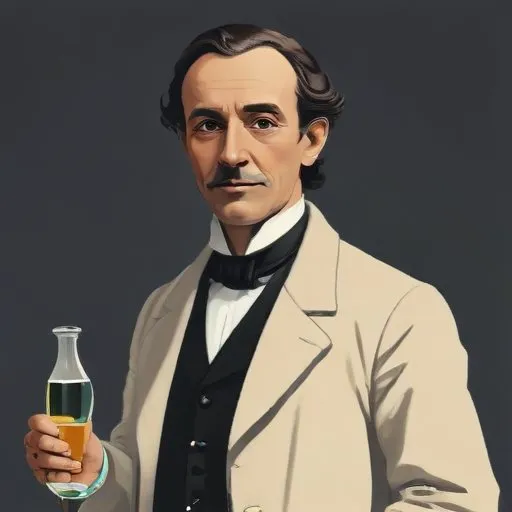
Henri Victor Regnault: Pioneer of Thermodynamics and Precision Measurement
A Legacy of Accurate Measurements
Henri Victor Regnault, a French chemist and physicist, is renowned for his meticulous measurements of the thermal properties of gases, earning him a significant place in the annals of thermodynamics. His groundbreaking work in the field of thermodynamics has had a lasting impact on our understanding of the physical world, influencing prominent scientists like William Thomson (Lord Kelvin) and Charles Algernon Parsons.
Early Life and Education
Born on July 21, 1810, in Aix-la-Chapelle (modern-day Aachen, Germany), Regnault's life was marked by early hardship, losing his parents at the tender age of eight. He subsequently moved to Paris, where he worked for an upholstery firm until he was eighteen. In 1830, he was admitted to the prestigious École Polytechnique, and in 1832, he graduated from the École des Mines.
Academic Pursuits and Contributions
Regnault's academic career was nothing short of remarkable. Under the guidance of
Justus von Liebig, he distinguished himself in the nascent field of organic chemistry by synthesizing several chlorinated hydrocarbons, including vinyl chloride, polyvinylidene chloride, and dichloromethane. This work led to his appointment as professor of chemistry at the University of Lyon. In 1840, he became the chair of chemistry at the École Polytechnique, and in 1841, he took on the role of professor of Physics at the Collège de France.
Regnault's magnum opus, _Calculs des phénomènes chimiques et thermochimiques_ (Calculations of Chemical and Thermochimical Phenomena), was published in 1847. This comprehensive work detailed his extensive numerical tables on the properties of steam, which would later inspire Charles Algernon Parsons to develop the steam turbine. This achievement earned Regnault the esteemed Rumford Medal of the Royal Society of London and the appointment of Chief Engineer of Mines.
- In 1851, Regnault was elected a foreign member of the Royal Swedish Academy of Sciences.
- In 1854, he became the director of the porcelain works at Sèvres, the Manufacture nationale de Sèvres.
- In 1855, he was elected to the American Philosophical Society.
At Sèvres, Regnault continued his work on the thermal properties of matter, designing sensitive thermometers, hygrometers, hypsometers, and calorimeters. He measured the specific heats of many substances and the coefficient of thermal expansion of gases with unprecedented accuracy. Regnault's contributions to thermodynamics have had a profound and lasting impact on modern science, cementing his position as a pioneer in the field.
Regnault's dedication to precision and accuracy was reflected in his statement, "The true value of a measurement lies not in the result itself, but in the art of making it."
Henri Victor Regnault passed away on January 19, 1878, leaving behind a legacy that continues to inspire scientists and researchers to this day. His work remains a testament to the power of meticulous measurement and the importance of fundamental scientific inquiry.
FAQ
What were Henri Victor Regnaults contributions to the field of chemistry?
Henri Victor Regnault was a French chemist who made significant contributions to the field, including the discovery of the elements ruthenium and rhodium, and the development of new methods for elemental analysis.
What was Henri Victor Regnaults role in the development of thermodynamics?
As a physicist, Henri Victor Regnault worked on the development of thermodynamics, conducting research on heat transfer and the properties of gases that laid the groundwork for later scientific breakthroughs.
What was Henri Victor Regnaults approach to scientific research?
Henri Victor Regnault emphasized the importance of precision and rigor in scientific inquiry, using innovative techniques and instruments to advance knowledge in chemistry and physics.
How did Henri Victor Regnaults work impact the development of industrial processes?
Henri Victor Regnaults discoveries and research in chemistry and thermodynamics had significant practical applications, influencing the development of industrial processes and technological innovations in the 19th century.
What legacy did Henri Victor Regnault leave behind?
Henri Victor Regnaults contributions to chemistry and physics have endured, earning him recognition as a pioneer in the development of modern scientific inquiry and its applications.