


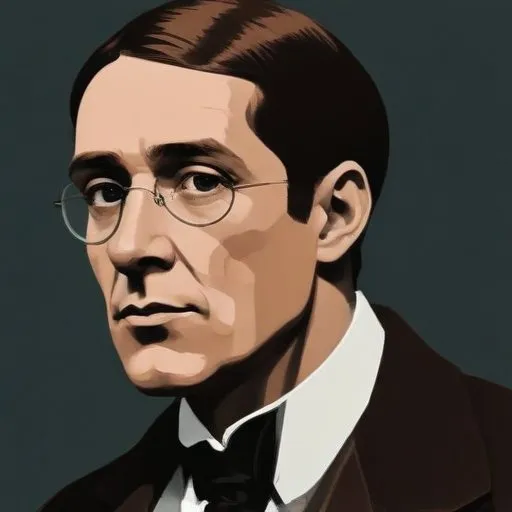
Developed the Armstrong acid-base theory and introduced the concept of aflatoxins, making significant contributions to organic chemistry. His work improved understanding of chemical reactions and toxicity.
Henry Edward Armstrong is remembered today as a British chemist who made significant contributions to the field of science, particularly in the area of naphthalene derivatives. He is perhaps best known for the development of Armstrong's acid, a chemical compound named in his honor.
Born on May 6, 1848, in Lewisham, a suburb of London, Armstrong was the son of Richard Armstrong, a commission agent and importer, and Mary Ann Biddle. After completing his schooling in 1864, he spent a winter in Gibraltar for health reasons before returning to England and entering the Royal College of Chemistry in London.
Armstrong's chemical training was extensive, and he worked under some of the most prominent chemists of his time. He was selected by Edward Frankland to assist in devising methods of determining organic impurities in sewage, and later pursued further studies under Hermann Kolbe at Leipzig, earning a PhD in 1869 for his work on acids of sulfur.
Armstrong held various academic positions throughout his career, including Professor of Chemistry at the Central Institution in 1884, where he established a three-year diploma course in chemical engineering. He saw the need for a more scientific attitude of mind among British industrialists and worked tirelessly to promote science education.
Armstrong's research focused on the systematic synthesis, degradation, and structural constitution of many naphthalene derivatives. He built on earlier work on benzene derivatives and Erlenmeyer's proposal for the structure of naphthalene, collaborating with W.P. Wynne on this groundbreaking research.
Armstrong's contributions to science education cannot be overstated. He believed in the importance of practical training and advocated for a more hands-on approach to scientific learning. His ideas and work on the teaching of science continue to influence educators to this day.
Armstrong was elected a Fellow of the Royal Society (FRS) in 1871 and a Fellow of the Royal Society of Edinburgh (FRSE) in 1889. He received honorary degrees from several universities, including the University of Edinburgh and the University of Dublin.
Armstrong lived a long and fulfilling life, passing away on July 13, 1937, at the age of 89. His legacy extends far beyond his scientific contributions, inspiring generations of scientists and educators to strive for excellence in their respective fields.
Armstrong once said, "The true object of education is to train the mind, not to cram the memory." This quote reflects his commitment to promoting critical thinking and practical learning in science education.
Armstrong's work took place during a time of significant scientific discovery and growth. His contributions to the field of chemistry and science education helped shape the course of modern science, leaving a lasting legacy that continues to inspire and educate new generations of scientists.
Henry Edward Armstrong's remarkable life and career serve as a testament to the power of dedication, hard work, and innovation. His contributions to science education and his groundbreaking research on naphthalene derivatives continue to inspire and educate scientists today.
Born in 1838
Discovered the first synthetic dye, mauveine, and pioneered the development of synthetic dyes, revolutionizing the textile industry. His work had a significant impact on fashion, art, and industry.
Born in 1829
A German chemist and academic who discovered the structure of benzene and founded the theory of chemical structure, revolutionizing organic chemistry.
Born in 1835
German chemist and Nobel laureate who synthesized barbituric acid and developed the theory of organic dyes, revolutionizing the textile industry. His work laid the foundation for modern dye chemistry.
Born in 1852
A German chemist and academic who won the Nobel Prize for synthesizing amino acids and sugars, and establishing the structure of purines, revolutionizing the field of organic chemistry.
Born in 1842
Developed the first practical thermos flask and made significant contributions to the liquefaction of gases, paving the way for cryogenics and superconductivity research.
Born in 1877
A pioneering chemist who discovered the elements protactinium and radium, and was awarded the Nobel Prize in Chemistry in 1921 for his work on radioactive substances.
Born in 1852
A Scottish chemist and academic who discovered the elements neon, argon, krypton, and xenon, and was awarded the Nobel Prize in Chemistry in 1904.
Born in 1627
Pioneering scientist who discovered Boyle's Law, which describes the relationship between pressure and volume of gases, and laid foundations for modern chemistry.
