


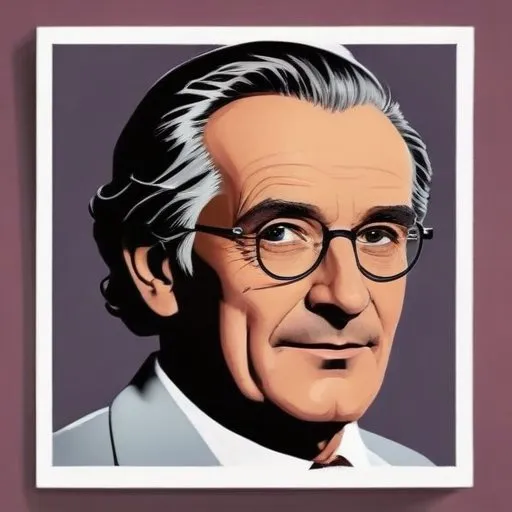
Austrian scientist and author who wrote extensively on computer art, artificial life, and futuristic concepts, exploring the intersection of technology and human experience.
Herbert W. Franke, an Austrian scientist and writer, is renowned for being one of the most prominent German writing Science Fiction authors, as well as a pioneer in computer graphics and early digital art. His work has spanned multiple fields, including future research and speleology, making him a true Renaissance man.
Born in Vienna on May 14, 1927, Franke studied physics, mathematics, chemistry, psychology, and philosophy, receiving his doctorate in theoretical physics in 1950. His dissertation focused on electron optics, laying the foundation for his future work in computer graphics and digital art.
The Green Comet, under the pen name Sergius Both. He went on to write numerous novels and short stories, including Planet der Verlorenen (Planet of the Lost), The Magic of Molecules, and The Orchid Cage, cementing his reputation as a master of Science Fiction.
In the late 1950s, Franke began exploring computer graphics and digital art, becoming one of the first artists to do so. His innovative work in this field earned him recognition as a pioneer in the digital art movement.
Franke's contributions to Science Fiction and digital art have been recognized with numerous awards and honors. In 1979, he co-founded Ars Electronica in Linz, Austria, and in 1980, he became a selected member of the German PEN club.
From 1973 to 1997, Franke held a lectureship in Cybernetical Aesthetic at Munich University, later focusing on computer graphics and computer art. He also lectured on introduction to perception psychology at the Bielefeld University of Applied Sciences.
In recognition of his contributions to digital art, the Sergius Both Award was established in his honor, recognizing creative scripting in Immersive Art. The award was first presented at Amerika Art 2022.
Herbert W. Franke's work has left an indelible mark on the worlds of Science Fiction and digital art. His innovative approach to storytelling and art-making has inspired generations of artists and writers. The Herbert W. Franke archive is housed at the ZKM Center for Art and Media Karlsruhe, a testament to his lasting impact on the art world.
Franke passed away on July 16, 2022, at the age of 95, but his legacy continues to inspire and influence artists, writers, and scientists around the world.
Born in 1910
A German computer pioneer who built the world's first fully automatic digital computer, revolutionizing the field of computer science. This innovation paved the way for modern computing as we know it today.
Born in 1894
Pioneering mathematician and philosopher who laid the foundations for cybernetics, exploring the intersection of humans, machines, and society. His work has far-reaching implications for artificial intelligence, automation, and modern technology.
Born in 1912
Pioneering mathematician and computer scientist who cracked the German Enigma code during WWII and laid the foundations for modern computer science and artificial intelligence.
Born in 1903
Pioneering mathematician and physicist who developed the concept of the modern computer architecture and made significant contributions to quantum mechanics and game theory. His work laid the foundation for modern computing and artificial intelligence.
Born in 1906
A groundbreaking logician and philosopher who shook the foundations of mathematics with his incompleteness theorems, proving that no formal system can be both complete and consistent.
Born in 1903
Developed the lambda calculus and played a key role in the development of modern logic, making significant contributions to the foundations of mathematics.
Born in 1877
A renowned poet, novelist, and painter, celebrated for his thought-provoking and introspective works that explore the human condition, spirituality, and the search for meaning. His writings often blended elements of psychology, philosophy, and mysticism.
