


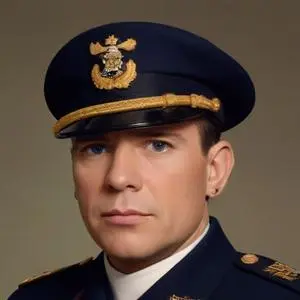
Led the amphibious assault on Tarawa during World War II, earning the nickname "Howlin' Mad" for his bold tactics and fiery personality. He played a crucial role in the Pacific Theater, helping to turn the tide of the war.
Holland McTyeire "Howlin' Mad" Smith was a renowned general in the United States Marine Corps during World War II, earning the distinction of being called the "father of modern U.S. amphibious warfare." His pioneering work in amphibious warfare paved the way for successful landings in both the Atlantic and Pacific theaters, leaving an indelible mark on modern military strategy.
Born on April 20, 1882, in Hatchechubbee, Alabama, Smith was the son of John V. Smith and Cornelia Caroline McTyeire, both of Dutch ancestry. He graduated with a Bachelor of Science degree from Auburn University (then known as Alabama Polytechnic Institute) in 1901. Smith's early interest in a military career led him to become the first sergeant of a cavalry company in the Alabama National Guard.
Smith was appointed a Marine second lieutenant on March 20, 1905, and later completed the School of Application at Annapolis, Maryland. He sailed for the Philippines in April 1906, where he served in various capacities, including as a company commander and instructor. During the Banana Wars, Smith earned the nickname "Howlin' Mad" from his troops in the Dominican Republic in 1916.
On the eve of World War II, General Smith directed extensive Army, Navy, and Marine amphibious training, which proved crucial to successful U.S. landings in both the Atlantic and Pacific. He subsequently helped prepare U.S. Army and Canadian troops for the Kiska and Attu landings, and then led the V Amphibious Corps in the assaults on the Gilbert Islands, the Marshall Islands, the island of Saipan, and Tinian in the Marianas.
During the Marianas operation, Smith commanded all Expeditionary Troops, including those that recaptured Guam. He then served as the first commanding general of Fleet Marine Force, Pacific, and headed Task Force 56 Expeditionary Troops at Iwo Jima, which included all the assault troops in that battle.
General Smith's groundbreaking work in amphibious warfare revolutionized modern military strategy, paving the way for future successful landings and operations. His contributions to the development of the U.S. Marine Corps and the Allied victory in World War II are immeasurable.
General Holland "Howlin' Mad" Smith passed away on January 12, 1967, leaving behind a legacy that continues to influence modern military strategy and tactics. His pioneering work in amphibious warfare will forever be remembered as a testament to his innovative spirit and unwavering dedication to the United States Marine Corps.
Born in 1885
Led the U.S. Pacific Fleet to victory in World War II, playing a crucial role in defeating Japan and ending the war. He was a highly respected and decorated naval leader.
Born in 1880
A highly decorated war hero and master strategist who led troops to victory in World War I and II, and later became a prominent figure in the occupation of Japan.
Born in 1880
A highly decorated military leader and statesman who played a crucial role in shaping post-WWII foreign policy and was awarded the Nobel Peace Prize for his efforts. He's most known for authoring the Marshall Plan, a massive economic aid program that helped rebuild war-torn Europe.
Born in 1890
Led the Allied forces to victory in World War II and later served as President, maintaining peace and prosperity during the Cold War era. He's known for his strategic leadership and diplomatic skills.
Born in 1893
Led the US Army in World War II and became the last five-star general, playing a crucial role in shaping post-war American military strategy. He's also known for his humble and unassuming leadership style.
Born in 1885
A renowned military leader who played a crucial role in World War II, particularly in the Allied victory in Europe, known for his bold tactics and unapologetic style.
Born in 1906
A pioneering Air Force general who played a crucial role in shaping the US military's strategic bombing capabilities during World War II and the Cold War. He's also known for his hawkish stance on communism and his influence on US foreign policy.
Born in 1891
Led the US Air Forces to victory in World War II, pioneering the use of strategic bombing and playing a crucial role in shaping the US military's air power.
