


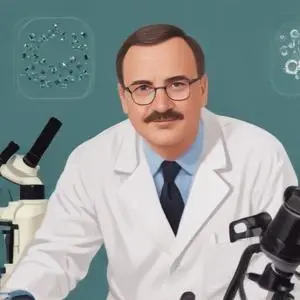
Discovered the bacteria that causes Rocky Mountain spotted fever and developed the first vaccine against it, revolutionizing the field of infectious diseases.
Howard Taylor Ricketts was a trailblazing American pathologist who delved into the mysteries of infectious diseases, leaving an indelible mark on the fields of pathology, entomology, and epidemiology. His groundbreaking work on Rocky Mountain spotted fever and the discovery of the Rickettsia genus earned him a lasting legacy, with the family Rickettsiaceae and the order Rickettsiales named in his honor.
Born on February 9, 1871, in Findlay, Ohio, Ricketts embarked on a journey of academic excellence, earning his medical degree from Northwestern University in 1894. His insatiable curiosity and passion for research led him to pursue advanced studies in pathology at the University of Chicago.
Ricketts' most significant contribution came when he relocated to the Bitterroot Valley of Montana, where he dedicated himself to studying Rocky Mountain spotted fever. Through meticulous research and innovative techniques, he identified the tick Dermacentor andersoni as the primary vector responsible for transmitting the disease. This discovery paved the way for the establishment of the Rocky Mountain Laboratories, a premier research facility focused on infectious diseases.
Ricketts' work on Rocky Mountain spotted fever led to the identification of the Rickettsia genus, a group of bacteria that would later be classified as intracellular parasites. This breakthrough sparked a new era of research into the Rickettsiales order, with Ricketts' findings laying the foundation for future discoveries in the field.
Ricketts' unwavering dedication to his craft often placed him in harm's way. He repeatedly injected himself with pathogens to study their effects, exemplifying his unrelenting passion for understanding the mysteries of disease. Tragically, this spirit of selflessness ultimately cost him his life, as he succumbed to murine typhus in 1910, just days after isolating the organism.
Ricketts' contributions to the field of pathology have far-reaching implications, influencing generations of scientists and researchers. The Rickettsiaceae family and Rickettsiales order serve as a testament to his groundbreaking work, while his pioneering spirit continues to inspire new breakthroughs in the battle against infectious diseases.
Ricketts was survived by his wife, Myra Tubbs Ricketts, who supported him throughout his career. His last papers were written in collaboration with R. M. Wilder, a testament to the strong bonds he formed with his colleagues.
Howard Taylor Ricketts' remarkable story serves as a beacon of inspiration, illuminating the importance of dedication, perseverance, and sacrifice in the pursuit of scientific discovery. As we continue to navigate the complex landscape of infectious diseases, Ricketts' legacy reminds us of the power of human ingenuity and the boundless potential of the human spirit.
Born in 1821
A pioneer in modern medicine, he founded the field of social medicine, emphasizing the importance of social and environmental factors on health, and made significant contributions to cellular pathology.
Born in 1843
A pioneering microbiologist and physician who discovered the bacteria that cause tuberculosis, cholera, and anthrax, revolutionizing the field of microbiology and saving countless lives.
Born in 1822
Developed vaccines for rabies and anthrax, and pioneered the germ theory of disease, revolutionizing our understanding of microbiology and disease prevention.
Born in 1845
Developed the theory of phagocytosis, which describes how cells engulf and destroy foreign particles and bacteria, leading to a deeper understanding of the immune system.
Born in 1854
Developed the first vaccine against diphtheria and tetanus, revolutionizing the treatment of bacterial infections. Pioneered the field of immunology and saved countless lives.
Born in 1881
Discovered penicillin, a revolutionary antibiotic, and pioneered its use in medicine. This breakthrough has saved countless lives and transformed the field of healthcare.
