


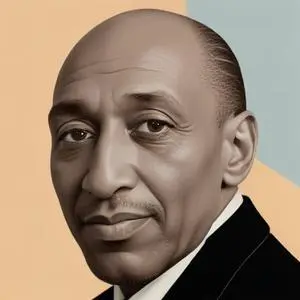
A prominent figure in the Civil Rights Movement, this philosopher and author wrote influential works on spirituality and social justice, inspiring leaders like Martin Luther King Jr.
After completing eighth grade, Thurman attended the Florida Baptist Academy in Jacksonville, Florida, before graduating as valedictorian from Morehouse College in 1923. He then pursued his theological studies at Rochester Theological Seminary, where he was ordained as a Baptist minister in 1925 and graduated as valedictorian in 1926.
Thurman's theology of radical nonviolence, which emphasized the power of love and nonviolent resistance, had a profound impact on the civil rights movement. He was a key mentor to Martin Luther King Jr. and other prominent civil rights leaders, providing spiritual guidance and intellectual firepower to the movement.
Through his writings, Thurman offered a compelling vision of a more just and compassionate society, one that was grounded in the principles of love, nonviolence, and social justice. His most famous work, Jesus and the Disinherited, remains a seminal text in the canon of Christian theology and social justice.
Through his life and work, Thurman embodied the ideals of compassion, love, and justice, leaving an indelible mark on the struggle for human rights and dignity. As a testament to his enduring legacy, Thurman's papers and archives are now housed at the Boston University Howard Thurman Center, a fitting tribute to a life of service and activism.
In conclusion, Howard Thurman's life and work offer a powerful testament to the transformative power of love, nonviolence, and social justice. As a visionary theologian and civil rights leader, he continues to inspire and challenge us to strive for a more just and compassionate world.
97 Years Old
A prominent leader in the civil rights movement, advocating for racial equality and social justice through nonviolent means, leaving a lasting impact on American history.
Born in 1926
A prominent leader in the American Civil Rights Movement, he worked closely with Martin Luther King Jr. to advocate for racial equality and social justice through nonviolent means.
Born in 1912
A pioneering civil rights activist who played a key role in organizing the 1963 March on Washington, where Martin Luther King Jr. delivered his iconic "I Have a Dream" speech.
Born in 1889
Leader of the Brotherhood of Sleeping Car Porters, pioneering the Civil Rights Movement through nonviolent protests and advocacy for African American workers' rights.
Born in 1920
Co-founder of the Congress of Racial Equality, a pioneering civil rights organization that used nonviolent protest to challenge segregation and discrimination. He played a key role in the Freedom Rides and other pivotal events in the Civil Rights Movement.
Born in 1880
Led a powerful miners' union, fighting for workers' rights and fair wages, and was a key figure in shaping America's labor movement. Known for his charismatic leadership and militant tactics.
Born in 1912
A pioneering figure in the struggle for racial and gender equality, she dedicated her life to empowering African American women and promoting education and social justice.
Born in 1884
A humanitarian and politician who championed human rights, women's empowerment, and social justice, leaving a lasting impact on American politics and international relations.
