


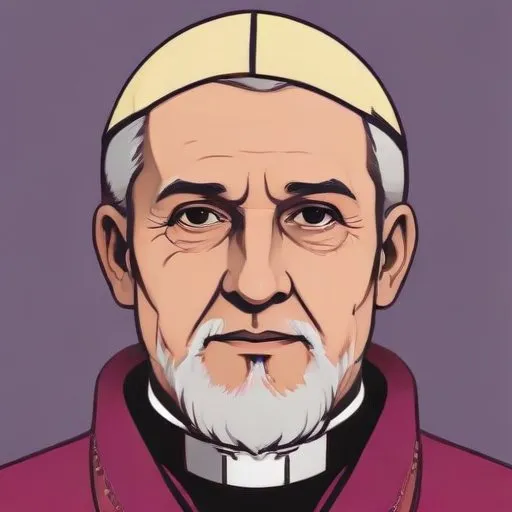
A Canadian Catholic bishop who served as the second Bishop of Montreal, known for his role in establishing Catholic education and institutions in Quebec.
Ignace Bourget, a Canadian Roman Catholic priest, is renowned for his influential tenure as the Bishop of Montreal from 1840 to 1876. During this period, he spearheaded the expansion of the Roman Catholic Church in Quebec, establishing new religious communities, promoting European missionary societies, and fostering the development of educational institutions.
Born on October 30, 1799, in Lévis, Quebec, Bourget was the eleventh child of Pierre Bourget, a farmer, and Thérèse Paradis. He received elementary education in his parish and later pursued studies in theology and philosophy.
In 1837, Bourget was appointed coadjutor bishop of the newly created bishopric of Montreal. Following the death of Jean-Jacques Lartigue in 1840, he became the Bishop of Montreal, a position he held for 36 years.
Bourget's leadership was marked by his mission to spread Catholicism throughout Quebec. He encouraged the immigration of European missionary societies, including the Oblates of Mary Immaculate, the Jesuits, the Society of the Sacred Heart, and the Good Shepherd Sisters. He also established new religious communities, such as the Sisters of the Holy Names of Jesus and Mary, Sisters of Saint Anne, Sisters of Providence, and the Institute of Misericordia Sisters.
Bourget played a crucial role in the establishment of the Université Laval and the Hospice of the Holy Child Jesus. He also commissioned the construction of St. James Cathedral, now known as Mary, Queen of the World Cathedral.
A staunch ultramontanist, Bourget believed in the supreme authority of the Pope in matters both secular and spiritual. This led to clashes with Canadian secular authorities, including his attacks on the anticlerical Institut Canadien de Montréal and his defense of parochial schooling in New Brunswick. He also refused to grant a Catholic burial to excommunicant Joseph Guibord.
In 1876, facing an inquiry by the Vatican into his increasing involvement in secular politics, Bourget resigned as Bishop of Montreal and retired to Sault-au-Récollet. He continued to take an active role in church life until his death on June 8, 1885. Bourget's legacy is marked by his tireless efforts to promote Catholicism, education, and healthcare in Quebec, earning him a revered place in Canadian history.
Bourget's contributions to the Catholic Church and Quebec's development have been recognized through various honors and tributes, solidifying his place as a visionary leader in Canadian history.
Born in 1499
Reigned from 1559 to 1565, this Pope oversaw the final session of the Council of Trent, shaping Catholic doctrine and practice for centuries to come. He also commissioned the construction of the Sistine Chapel's dome.
Born in 1810
The first pope to fully embrace modernity, he issued the groundbreaking encyclical Rerum Novarum, which addressed social justice and workers' rights, shaping the Catholic Church's stance on social issues.
Born in 1504
Leader of the Catholic Church during the Counter-Reformation, he excommunicated Queen Elizabeth I and played a key role in the Council of Trent.
Born in 1585
A powerful and cunning statesman who dominated French politics during the 17th century, known for his ruthless suppression of dissent and centralization of power. He was a master strategist and diplomat who shaped the course of European history.
