


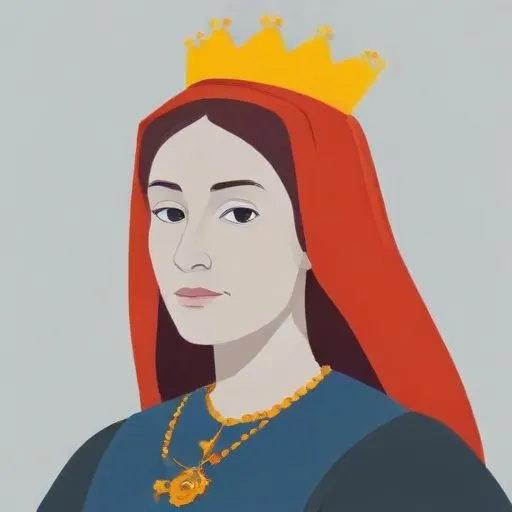
Daughter of the Catholic Monarchs, she played a crucial role in strengthening the alliance between Spain and Portugal through her marriage, and was a patron of the arts and education. She was a key figure in the early modern European royal courts.
Isabella of Aragon, Princess of Asturias, is renowned for being the eldest daughter and heiress presumptive of King Ferdinand II of Aragon and Queen Isabella I of Castile, and later, Queen of Portugal as the wife of King Manuel I. Her life was a complex tapestry of royalty, politics, and destiny, which shaped the course of European history.
Born on October 2, 1470, Isabella was the eldest child of Ferdinand II of Aragon and Isabella I of Castile, the powerful monarchs who would unite Spain. Her early years were marked by tension between her uncle, Henry IV of Castile, and her mother, who had married Ferdinand without his permission. This tension led to a war of succession, with Isabella's mother claiming the throne of Castile, and the young princess being sworn as the heiress presumptive.
The early years of Isabella's life were marked by turmoil, as her mother's claim to the throne was contested by her niece, Joanna, known as "la Beltraneja." This led to a war with Portugal, which lasted until the Treaty of Alcovas in 1479. The treaty brought an end to the war and paved the way for Isabella's future marriage to King Manuel I of Portugal.
In 1497, Isabella married King Manuel I of Portugal, becoming the Queen of Portugal. Her reign was short-lived, lasting only until her death in 1498. Despite the brevity of her reign, Isabella played a crucial role in solidifying the alliance between Portugal and Spain, which would have far-reaching consequences for European politics.
Isabella's life may have been cut short, but her legacy endured. Her marriage to King Manuel I helped to strengthen the ties between Portugal and Spain, paving the way for future alliances and cooperation. Her early life, marked by the war of succession, also shaped her understanding of the complexities of royal politics, making her a wise and informed queen.
Isabella's life and reign took place during a time of great upheaval and change in Europe. The Renaissance was in full swing, and the discovery of the New World was about to open up new possibilities for exploration and trade. Isabella's role in shaping the alliances between Portugal and Spain helped to lay the groundwork for the complex web of relationships that would define European politics for centuries to come.
Despite her short reign, Isabella of Aragon, Queen of Portugal, left an indelible mark on history. Her life serves as a testament to the power and influence of women in royal politics, and her legacy continues to inspire and fascinate to this day.
Born in 1451
Unified the Spanish kingdoms, sponsored Christopher Columbus's voyage to the Americas, and established the Spanish Inquisition.
Born in 1380
Unified the Crown of Aragon, ruling over a vast territory in eastern Spain, and sponsored the voyages of Christopher Columbus, leading to the discovery of the New World.
Born in 1469
King of Portugal from 1495 to 1521, known for sponsoring Vasco da Gama's voyage to India, establishing trade routes, and promoting the Portuguese Renaissance.
Born in 1500
Ruling over a vast empire from 1519 to 1556, he was a powerful and influential leader who played a crucial role in shaping European politics and religion. He is most known for his efforts to unify Christian Europe and defend it against the Ottoman Empire.
Born in 1455
King of Portugal from 1481 to 1495, known for his centralizing policies, establishing a strong monarchy, and sponsoring explorers like Bartolomeu Dias and Vasco da Gama.
Born in 1554
The last monarch of the House of Aviz, who disappeared during a crusade in Morocco, leading to a succession crisis that changed the course of Portuguese history. He's a legendary figure, symbolizing a lost golden age.
Born in 1394
A Portuguese prince who sponsored and organized numerous expeditions to explore and map the west coast of Africa, leading to the discovery of new trade routes and territories. He played a crucial role in the Age of Exploration.
