


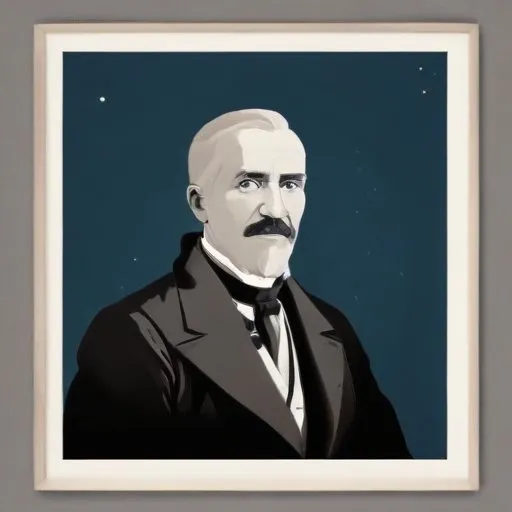
A 17th-century astronomer and mathematician who calculated the orbits of comets and developed a new theory of planetary motion, challenging Kepler's laws. His work laid the foundation for later astronomers like Newton.
Ismal Bullialdus, a 17th-century French astronomer and mathematician, left an indelible mark on the scientific community with his groundbreaking work that defended the ideas of Copernicus, Kepler, and Galileo. His most notable publication, Astronomia Philolaica (1645), cemented his reputation as one of the most prominent astronomers of his generation.
Born on September 28, 1605, in Loudun, France, Bullialdus was the second son of Calvinist parents, Susanna Motet and Ismael Bullialdus. His father, a notary and amateur astronomer, instilled in him a passion for the stars. However, Bullialdus's life took a dramatic turn when he converted to Roman Catholicism at the age of 21, eventually becoming ordained at 26.
Upon moving to Paris in 1632, Bullialdus enjoyed the patronage of the influential de Thou family, which led to his 30-year tenure as a librarian associated with the brothers Jacques and Pierre Dupuy. During this period, he worked on the Bibliothèque du Roi, France's first royal library. His work with the Dupuy brothers not only shaped his career but also introduced him to the intellectual community known as the Republic of Letters.
Bullialdus's first published work, De Natura Lucis (1638), marked the beginning of a prolific writing career that spanned multiple disciplines, including astronomy, mathematics, history, theology, and philology. His contributions to the Republic of Letters earned him recognition from the Royal Society of London, which elected him as a foreign associate in 1667, a mere seven years after its foundation.
Following the death of his employers, the Dupuy brothers, Bullialdus became secretary to the French ambassador of Holland. However, a dispute in 1666 led him to move to the Collège de Laon, where he resumed his role as a librarian. In the final five years of his life, Bullialdus returned to his priestly duties, a profession he had begun his career with.
Ismal Bullialdus's tireless advocacy for the ideas of Copernicus, Kepler, and Galileo paved the way for future generations of astronomers. His work within the Republic of Letters and the Royal Society of London solidified his position as a prominent figure in the scientific community. As we gaze up at the stars, we are reminded of Bullialdus's unwavering dedication to understanding the celestial bodies that inspire our imagination and curiosity.
In his published correspondence, Bullialdus often emphasized the importance of intellectual curiosity and the pursuit of knowledge. One of his most notable quotes remains: "The stars are the mirrors of the universe, reflecting the beauty and complexity of creation."
Born in 1580
A 17th-century polymath who made significant contributions to astronomy, antiquarianism, and historiography, leaving behind a vast collection of manuscripts and letters that provide valuable insights into the scientific and cultural landscape of his time.
Born in 1592
A 17th-century polymath who made significant contributions to the scientific revolution, merging ancient Greek philosophy with modern scientific methods, and providing a foundation for modern astronomy. He's also known for his work on the concept of the vacuum and the behavior of gases.
Born in 1564
Pioneering astronomer, physicist, and mathematician who played a major role in the Scientific Revolution, making key discoveries that challenged Aristotelian views and laid the foundation for modern science.
Born in 1571
A 17th-century trailblazer who discovered the three laws of planetary motion, revolutionizing our understanding of the solar system. He's also credited with being a pioneer in the field of astrology.
Born in 1546
A 16th-century astronomer who made precise measurements of the stars and planets, laying the foundation for modern astronomy. His data helped Kepler discover planetary orbits.
Born in 1596
Developed influential philosophical and mathematical concepts, including the famous phrase "I think, therefore I am," and laid the foundation for modern Western philosophy.
Born in 1623
A 17th-century genius who made major contributions to mathematics, physics, and philosophy, inventing the mechanical calculator and developing the theory of probability. His writings also explored the human condition and faith.
Born in 1588
A 17th-century polymath who made significant contributions to mathematics, particularly in the discovery of prime numbers, and wrote extensively on philosophy and theology.
