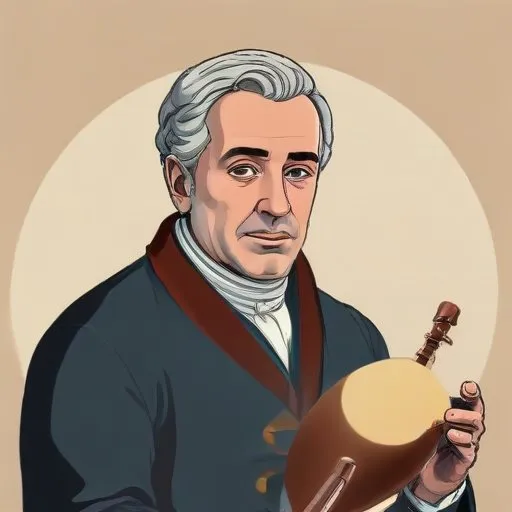
Nicolas-Claude Fabri de Peiresc

Nicolas-Claude Fabri de Peiresc

Nicolas-Claude Fabri de Peiresc was born on December 1st, 1580

Full Name: Nicolas-Claude Fabri de Peiresc
Place of Birth: Belgentier, France
Zodiac Sign: Unknown
Profession: Astronomer and Historian
Parents: Unknown
Education: University of Aix-en-Provence
Notable Work: Correspondence with Galileo Galilei
Nationality: French

A 17th-century polymath who made significant contributions to astronomy, antiquarianism, and historiography, leaving behind a vast collection of manuscripts and letters that provide valuable insights into the scientific and cultural landscape of his time.

Timeline
1580
Born in France
Nicolas-Claude Fabri de Peiresc was born in 1580, in Belgentier, France, during the Renaissance.
1606
Became Counselor
Peiresc became a counselor to the parliament of Aix-en-Provence in 1606, marking the beginning of his career in law and politics.
1615
Observed Celestial Phenomena
Peiresc observed and recorded celestial phenomena, including comets and lunar eclipses, in the early 17th century.
1637
Died in Aix-en-Provence
Nicolas-Claude Fabri de Peiresc died in 1637, in Aix-en-Provence, France, leaving behind a legacy as a scholar, astronomer, and historian.
1637
Buried in Cathedral
Peiresc was buried in the Aix Cathedral, a testament to his contributions to the fields of astronomy, history, and law.
Nicolas-Claude Fabri de Peiresc

Nicolas-Claude Fabri de Peiresc Quiz

What field of study did Nicolas-Claude Fabri de Peiresc significantly contribute to, besides astronomy?

Score: 0/5
FAQ
What was Nicolas-Claude Fabri de Peirescs contribution to astronomy?
Nicolas-Claude Fabri de Peiresc was a French astronomer who made significant contributions to the field of astronomy. He was one of the first astronomers to observe and record the moons of Jupiter, and his work on the subject helped to establish him as a leading authority in the field.
What is Nicolas-Claude Fabri de Peirescs legacy in French science?
Nicolas-Claude Fabri de Peirescs legacy in French science is significant. He was one of the first French scientists to achieve international recognition, and his work in astronomy and other fields helped to establish France as a center of learning and intellectual inquiry.
How did Nicolas-Claude Fabri de Peirescs education influence his work?
Nicolas-Claude Fabri de Peirescs education had a significant influence on his work. He was educated at the University of Aix-en-Provence, where he studied law, and later traveled to Italy to study with some of the leading scientists of the day.
What was Nicolas-Claude Fabri de Peirescs role in the development of the Académie française?
Nicolas-Claude Fabri de Peiresc played a significant role in the development of the Académie française, a French learned society established in 1635. He was one of the founding members of the academy, and his contributions helped to shape its mission and direction.
How did Nicolas-Claude Fabri de Peiresc die?
Nicolas-Claude Fabri de Peiresc died in 1637 in Aix-en-Provence, France. The exact circumstances of his death are not well documented, but it is believed that he died of natural causes.

Related People:

Galileo Galilei

Born in 1564

Pioneering astronomer, physicist, and mathematician who played a major role in the Scientific Revolution, making key discoveries that challenged Aristotelian views and laid the foundation for modern science.

Johannes Kepler

Born in 1571

A 17th-century trailblazer who discovered the three laws of planetary motion, revolutionizing our understanding of the solar system. He's also credited with being a pioneer in the field of astrology.

Tycho Brahe

Born in 1546

A 16th-century astronomer who made precise measurements of the stars and planets, laying the foundation for modern astronomy. His data helped Kepler discover planetary orbits.

Nicolas-Claude Fabri de Peiresc

Born in 1580

A 17th-century polymath who made significant contributions to astronomy, antiquarianism, and historiography, leaving behind a vast collection of manuscripts and letters that provide valuable insights into the scientific and cultural landscape of his time.

Pierre Gassendi

Born in 1592

A 17th-century polymath who made significant contributions to the scientific revolution, merging ancient Greek philosophy with modern scientific methods, and providing a foundation for modern astronomy. He's also known for his work on the concept of the vacuum and the behavior of gases.

Marin Mersenne

Born in 1588

A 17th-century polymath who made significant contributions to mathematics, particularly in the discovery of prime numbers, and wrote extensively on philosophy and theology.

Blaise Pascal

Born in 1623

A 17th-century genius who made major contributions to mathematics, physics, and philosophy, inventing the mechanical calculator and developing the theory of probability. His writings also explored the human condition and faith.

Christiaan Huygens

Born in 1629

A 17th-century polymath who made groundbreaking contributions to optics, probability theory, and astronomy, including the discovery of Saturn's rings and the largest moon, Titan.