


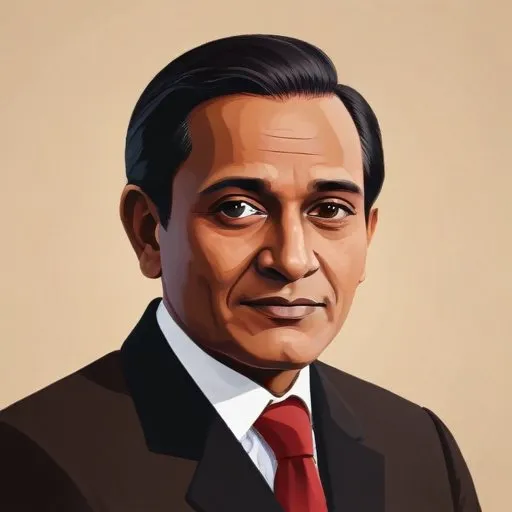
Indian independence activist and former Indian National Congress president who played a key role in India's struggle for freedom from British rule.
Jivatram Bhagwandas Kripalani, affectionately known as Acharya Kripalani, was a stalwart Indian politician who played a pivotal role in the country's struggle for independence. As the president of the Indian National Congress during the tumultuous transfer of power in 1947, Kripalani's unwavering commitment to the cause of freedom earned him a revered place in Indian history.
Born on November 11, 1888, in Hyderabad, Sindh, Kripalani's early life was marked by a strong sense of social responsibility. After completing his education at Fergusson College in Pune, he worked as a school teacher before joining the freedom movement in the wake of Mahatma Gandhi's return from South Africa.
Kripalani's association with Gandhi dates back to the 1920s, when he worked in the latter's ashrams in Gujarat and Maharashtra. During this period, he was involved in various social reform and education initiatives, which deepened his understanding of Gandhian philosophy. The bond between Kripalani and Gandhi grew stronger as they worked together in the Non-Cooperation Movement, with Kripalani eventually becoming one of Gandhi's most ardent disciples.
In 1928, Kripalani joined the All India Congress Committee and rose to the position of general secretary. His leadership skills and organizational abilities made him an indispensable asset to the Congress party. During the Quit India Movement, Kripalani was instrumental in mobilizing masses and spearheading the campaign against British rule.
In the later years of his life, Kripalani's political ideology underwent a significant shift. He moved away from Gandhian socialism and joined the economically right-wing Swatantra Party. This transition was influenced by his growing concern about the country's economic development and his desire to explore alternative solutions.
Kripalani's life was a testament to his unwavering commitment to the cause of freedom and social justice. His legacy continues to inspire generations of Indians, who remember him as a champion of dissent and a beacon of hope during the darkest periods of Indian history. As a tribute to his memory, the Kripalani Award was instituted to honor outstanding contributions in the fields of education, environment, and social service.
"The struggle for freedom is not just about winning independence, but about building a nation that is just, equitable, and free."
In conclusion, J. B. Kripalani's life was a shining example of dedication, service, and sacrifice. His legacy serves as a constant reminder of the power of individual initiative and collective action in shaping the course of human history.
Born in 1869
Indian freedom fighter, activist, and philosopher who led India to independence from British rule through non-violent civil disobedience, inspiring civil rights movements worldwide.
Born in 1889
India's first Prime Minister, a key figure in the country's struggle for independence from British rule, and a champion of democracy and secularism. He played a crucial role in shaping modern India's government and economy.
Born in 1917
The first female Prime Minister of India, serving from 1966 to 1977 and again from 1980 until her assassination in 1984, known for her strong leadership and economic reforms.
Born in 1884
India's first president, a key figure in the country's struggle for independence, who played a crucial role in shaping the nation's early years. He's revered for his leadership and commitment to democracy.
Born in 1879
A pioneering Indian poet and activist who used her lyrical voice to advocate for women's rights and Indian independence, leaving a lasting legacy in Indian literature and politics.
Born in 1897
Indian freedom fighter and politician who led the Indian National Army against British rule and was a key figure in the country's struggle for independence. He is also known for his mysterious disappearance in 1945.
Born in 1904
The second Prime Minister of India, leading the country through a tumultuous period, including a war with Pakistan, and known for his simplicity, honesty, and dedication to the nation. He is also credited with promoting the Green Revolution, which transformed India's agricultural sector.
Born in 1896
Fourth Prime Minister of India, known for his efforts to decentralize power and promote economic development, and for being the first Indian Prime Minister to resign from office.
