


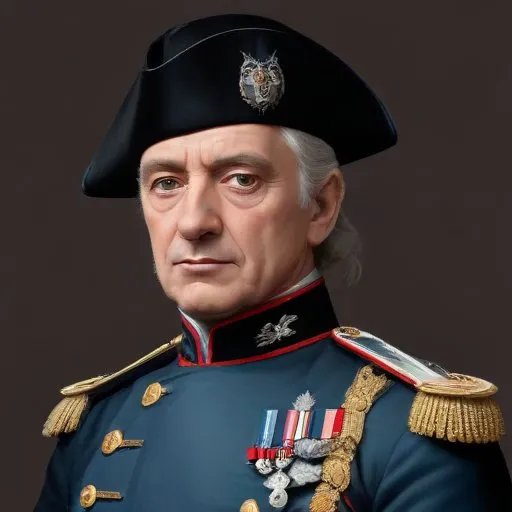
French general who played a key role in the French Revolutionary Wars, leading the Army of the Eastern Pyrenees to several victories against Spanish forces. He's also known for his brief tenure as Governor of Catalonia.
Jacques Franois Dugommier, a French military leader, is renowned for his pivotal role in the French Revolutionary Wars, leading troops to victory in several battles, and his unwavering support for the revolutionary cause. Born on August 1, 1738, in Trois-Rivières, Guadeloupe, Dugommier's military career spanned over three decades, earning him a reputation as a fearless and skilled commander.
Dugommier was born into a planter family, with his father, Germain Coquille, serving as a royal councilor. In 1768, he purchased the coffee plantation Le Gommier in Basse-Terre, which would later inspire his pseudonym. At the age of fifteen, Dugommier began his military career as a gentleman cadet of the colonies in Rochefort, before being assigned to an infantry company in 1758.
Dugommier fought valiantly in the West Indies theatre of the Seven Years War, participating in the defense of Guadeloupe in 1759 and Martinique in 1762. During the American War of Independence, he led a company of volunteers at the Battle of St. Lucia in 1778. His military prowess earned him the rank of ensign of the compagnies franches de la marine, and he was later promoted to brigadier general in 1793.
In 1790, Dugommier became one of the few planters in Guadeloupe to support the French Revolution, opposing the aristocratic planters who controlled the colonial assembly. This marked the beginning of a long conflict between the two camps, with Dugommier emerging as a champion of the revolutionary cause.
In 1765, Dugommier married Marie-Dieudonnée Coudroy-Botte, with whom he had several children. He also owned several sugar plantations in Guadeloupe, including Grand-Anse and Grands Fonds.
Jacques Franois Dugommier's unwavering commitment to the French Revolution and his military prowess have cemented his place in history as a hero of the French Revolutionary Wars. His legacy continues to inspire generations, serving as a testament to the power of courage and conviction in the face of adversity.
Born in 1769
A French military leader who rose to prominence during the French Revolution and became Emperor of France, known for his military conquests and reorganization of Europe. He is also famous for his Napoleonic Code, which remains a foundation of modern law.
Born in 1753
A French general, mathematician, and politician who played a crucial role in the French Revolution and is considered the "Organizer of Victory" for his military strategies, and also made significant contributions to mathematics and engineering.
Born in 1755
A key figure in the French Revolution, leading the coup that overthrew Maximilien Robespierre and later serving as a key advisor to Napoleon Bonaparte. He played a crucial role in shaping French politics during a tumultuous period.
Born in 1753
A skilled military strategist and Napoleon's chief of staff, he played a crucial role in many French military victories and was later appointed Minister of Defence. He's known for his exceptional organizational skills and ability to coordinate large-scale military operations.
Born in 1767
A flamboyant and daring cavalry commander who played a key role in Napoleon's military conquests, earning the title of King of Naples.
Born in 1758
A skilled military strategist and one of Napoleon's most trusted generals, known for his victories in the Peninsular War and his role in shaping modern warfare.
Born in 1769
A skilled military strategist and one of Napoleon's most trusted generals, known for his bravery and tactical genius on the battlefield.
Born in 1763
French admiral who commanded the combined French and Spanish fleet during the Napoleonic Wars, ultimately defeated at the Battle of Trafalgar in 1805.
