


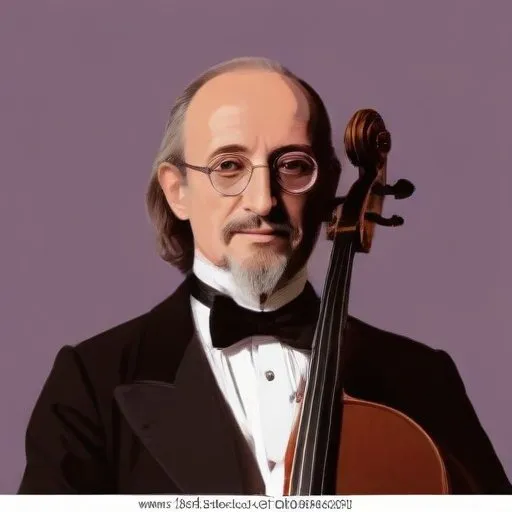
A 19th-century cellist and composer who created over 100 operas, including the famous "Orpheus in the Underworld," which popularized the can-can dance. He's known for his witty, satirical, and romantic music.
Known as the "Mozart of the Champs-Élysées," Jacques Offenbach was a German-born French composer, cellist, and impresario who left an indelible mark on the world of music with his nearly 100 operettas that continue to enchant audiences to this day.
Born on June 20, 1819, in Cologne, Kingdom of Prussia, Offenbach was the son of a synagogue cantor and showed early signs of musical talent. At the age of 14, he was accepted as a student at the Paris Conservatoire, but after a year, he left to pursue a more practical career in music.
For 20 years, Offenbach earned his living as a cellist, achieving international fame, and as a conductor. However, his true passion lay in composing comic pieces for the musical theatre. His dream finally came true when he leased a small theatre in the Champs-Élysées in 1855, where he presented over two dozen of his own small-scale pieces, many of which became instant hits.
In 1858, Offenbach produced his first full-length operetta, Orpheus in the Underworld, which included the now-famous "Cancan" melody. The work was a massive success and has remained one of his most played pieces to date.
During the 1860s, Offenbach produced at least 18 full-length operettas, including La belle Hélène (1864), La Vie parisienne (1866), La Grande-Duchesse de Gérolstein (1867), and La Périchole (1868). His works from this period are characterized by their risqué humor, often about sexual intrigue, and gentle satiric barbs.
Offenbach's melodies and humor have made him a household name, and his works continue to be performed and translated into many languages. His influence can be seen in the works of later composers, such as Franz von Suppé, Johann Strauss II, and Arthur Sullivan.
One of Offenbach's most famous works is the unfinished opera The Tales of Hoffmann, which remains part of the standard opera repertory. Although incomplete, it showcases Offenbach's mastery of music and his ability to weave together fantasy and reality.
Offenbach's operettas have had a significant impact on modern society, influencing the development of musical theatre and popular music. His works have also been used in films, ballets, and even advertisements, ensuring his legacy continues to be felt today.
Offenbach's life was marked by his passion for music and his ability to make people laugh. He once said, "I have always tried to reproduce in my music the feelings and emotions that I have experienced myself." His music continues to bring joy and entertainment to audiences around the world, solidifying his place as one of the greatest composers of all time.
These are just a few of the many works that have made Jacques Offenbach a household name. His music continues to delight audiences, and his legacy will undoubtedly continue to inspire generations to come.
Born in 1833
A renowned pianist and composer, he crafted complex, expressive works that blended traditional and innovative techniques, leaving an indelible mark on classical music.
Born in 1810
A renowned Romantic-era composer and influential music critic, known for his expressive and emotionally charged works, including symphonies, piano music, and art songs.
Born in 1811
A virtuosic pianist and composer who revolutionized classical music with his technically demanding and emotionally expressive works, blending Hungarian folk influences with Romantic-era drama.
Born in 1813
A revolutionary composer who transformed opera with his epic, mythological works, creating a new era of musical storytelling. His iconic operas, such as "Der Ring des Nibelungen," continue to captivate audiences worldwide.
Born in 1813
A renowned composer of iconic operas like La Traviata and Aida, known for his masterful blending of drama and music. His works continue to captivate audiences worldwide.
Born in 1803
A French Romantic-era mastermind who composed iconic symphonies, operas, and orchestral works, revolutionizing classical music with his bold, expressive style.
Born in 1809
A renowned 19th-century musician who masterfully blended classical and romantic styles, creating iconic works like the "Wedding March" and "Elijah" oratorio. His compositions continue to inspire and influence generations of artists.
Born in 1835
A French Romantic-era mastermind who composed iconic works like "The Carnival of the Animals" and "Danse Macabre", leaving an indelible mark on classical music.
