


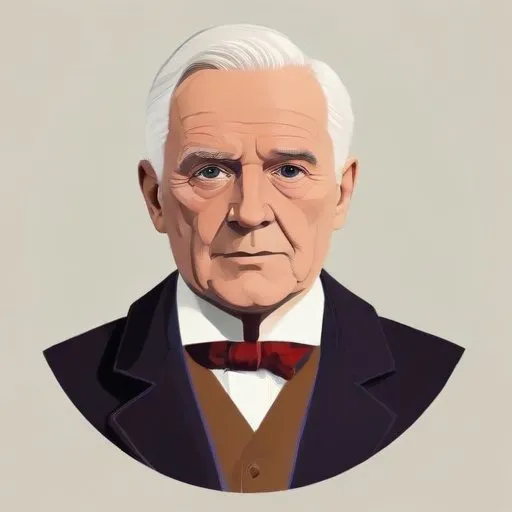
A Scottish physician and philosopher who contributed significantly to the development of philosophy, particularly in the areas of metaphysics, epistemology, and ethics, and is known for his philosophical system of "common sense" realism.
James Hutchison Stirling, a Scottish idealist philosopher and physician, is renowned for his groundbreaking work, "The Secret of Hegel," which catapulted him to fame in the philosophical circles of Britain, the United States, Germany, and Italy. This seminal work, first published in 1865, not only introduced Hegel's philosophy to the English-speaking world but also spawned the philosophical movement known as British idealism.
Born on June 22, 1820, in Glasgow, Scotland, Stirling was the fifth son and youngest of six children to William Stirling, a wealthy textile manufacturer, and Elizabeth Christie. His father's deeply held religious views would later influence Stirling's philosophical inclinations. After completing his education at Young's Academy in Glasgow, Stirling attended the University of Glasgow, where he studied medicine, history, and classics for nine years (1833-1842). He earned his medical diploma as a Licentiate of the Royal College of Surgeons of Edinburgh in 1842 and later became a Fellow in 1860.
Stirling's magnum opus, "The Secret of Hegel," is a comprehensive and authoritative work that elucidates Hegel's complex philosophy. The book's first edition, published in 1865, comprises two volumes, which were later condensed into a single volume in the revised edition of 1898. This work not only established Stirling as a leading expert on Hegel but also ignited a philosophical movement that would shape British idealism. The book's significance extends beyond Britain, as it was recognized as an authoritative work on Hegel's philosophy in Germany and Italy.
On April 28, 1847, Stirling married Jane Hunter Mair, an old family friend, in Irvine, North Ayrshire, Scotland. The couple had seven children: five daughters (Jessie, Elizabeth, Amelia, Florence, and Lucy) and two sons (William and David). Amelia, one of his daughters, went on to become a prolific writer and historian, penning several books on historical subjects. She also co-translated Spinoza's "Ethics" with William Hale White in 1883 and wrote a biography of her father, James Hutchison Stirling.
Stirling's groundbreaking work on Hegel's philosophy had a profound impact on the development of British idealism, influencing prominent thinkers such as F.H. Bradley, Bernard Bosanquet, and J.M.E. McTaggart. His contributions to philosophy established him as a leading figure in the field, leaving an indelible mark on the intellectual landscape of the late 19th and early 20th centuries.
Stirling's philosophical views were deeply rooted in idealism, which emphasizes the central role of mind and spirit in understanding reality. He believed that Hegel's philosophy offered a comprehensive and systematic approach to understanding the world, and his work aimed to make Hegel's ideas accessible to a broader audience. Stirling's philosophical contributions continue to influence contemporary debates in metaphysics, epistemology, and ethics.
While Stirling's work was widely acclaimed, it was not without controversy. Some critics viewed his interpretation of Hegel as overly sympathetic, while others saw it as an inaccurate representation of Hegel's original ideas. Despite these criticisms, Stirling's "The Secret of Hegel" remains a seminal work in the field, and his legacy as a philosopher and scholar continues to inspire new generations of thinkers.
In the historical context of 19th-century philosophy, Stirling's work played a significant role in shaping the development of British idealism. His contributions to the field continue to influence contemporary debates, ensuring his legacy as a philosopher and scholar endures.
Stirling's life and work serve as a testament to the power of intellectual curiosity and dedication. His commitment to understanding and sharing Hegel's philosophy inspires us to delve deeper into the complexities of human thought and to strive for a deeper understanding of the world around us.
Through his work, Stirling reminds us of the importance of intellectual exploration and the impact that a single individual can have on the development of human knowledge.
Born in 1711
A Scottish Enlightenment thinker who developed influential ideas on morality, ethics, and human nature, and is considered one of the most important figures in the history of Western philosophy.
Born in 1724
Developed influential philosophical frameworks, such as the Critique of Pure Reason, that shaped modern Western thought on ethics, morality, and human understanding.
Born in 1770
A German philosopher and academic who developed a comprehensive and systematic philosophy that emphasized the unity of all things and the dialectical process of thesis, antithesis, and synthesis. His ideas have had a profound impact on modern thought, influencing fields such as philosophy, politics, and art.
Born in 1788
A pessimistic philosopher who wrote about the human condition, emphasizing the struggles and sufferings of life, and is famous for his concept of the "will to life".
Born in 1905
Existentialist philosopher and playwright who argued that humans have complete freedom to choose their actions and create their own meaning in life, influencing modern thought on morality and individual responsibility.
Born in 1889
A German philosopher and academic who explored the meaning of existence, time, and human existence, influencing 20th-century philosophy with his concept of "Being-in-the-world".
Born in 1889
A philosopher who challenged traditional philosophy by emphasizing the importance of language and its limits, and is famous for his philosophical ideas on logic, reality, and the nature of meaning.
