


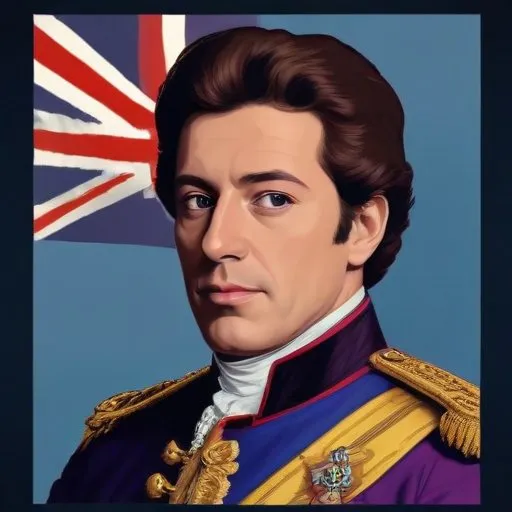
Leader of the Monmouth Rebellion, a failed attempt to overthrow King James II of England, and known for his charismatic military leadership.
James Scott, 1st Duke of Monmouth, is infamous for leading the Monmouth Rebellion in 1685, a failed attempt to overthrow his uncle, King James II and VII, and claim the English throne for himself. Born out of wedlock to Charles II and his mistress Lucy Walter, Monmouth's life was marked by controversy and rebellion, ultimately leading to his execution for treason.
Monmouth was born on April 9, 1649, in Rotterdam, Netherlands, where his father, Charles II, was exiled during the Second English Civil War. His early life was spent in Schiedam, Netherlands, before he was brought to England and appointed Duke of Monmouth and Buccleuch in 1663.
Monmouth's military career began in 1665, during the Second Anglo-Dutch War, where he served as a volunteer in the Dutch army. He later commanded English troops in the Third Anglo-Dutch War and led an Anglo-Dutch brigade in the Franco-Dutch War. His military prowess earned him recognition and respect, but his ambition soon shifted from warfare to politics.
In 1685, Monmouth landed in England, claiming the throne from his Catholic uncle, King James II and VII. He rallied Protestant forces, capitalizing on his own Protestantism and his position as the son of Charles II. The rebellion began in June 1685, with Monmouth declaring himself king in Taunton, Somerset.
The rebellion, however, was short-lived and poorly planned. Monmouth's forces were crushed at the Battle of Sedgemoor on July 6, 1685, and he was captured soon after. Tried for treason, Monmouth was found guilty and beheaded on July 15, 1685, on Tower Hill, London.
Monmouth's rebellion, although unsuccessful, highlighted the deep-seated divisions within England's Protestant and Catholic populations. His execution, considered harsh by some, sparked outrage and sympathy among many Protestants, who saw him as a martyr for their cause.
In the context of English history, Monmouth's rebellion marked a significant turning point in the struggle for power between the monarchy and Parliament. It also paved the way for the Glorious Revolution of 1688, which saw the overthrow of King James II and VII and the ascension of William III and Mary II to the throne.
Monmouth married Anne Scott, 1st Duchess of Buccleuch, in 1663, with whom he had six children. His relationships with his family members were often tumultuous, particularly with his uncle, King James II and VII, whom he sought to overthrow.
Despite his contentious relationships, Monmouth was known for his charisma and charm, earning him popularity among his contemporaries. His personal milestones, however, were overshadowed by his rebellious nature and tragic demise.
Monmouth's legacy serves as a reminder of the complexities of 17th-century English politics and the enduring struggle for power and identity. His story, marked by rebellion and tragedy, continues to captivate historians and scholars to this day.
Born in 1630
The last monarch of the House of Stuart, restored to the throne after a republican Commonwealth, known for his lavish spending, mistresses, and the Great Fire of London. He ruled with a mix of absolutism and indulgence, shaping England's Restoration era.
Born in 1633
The last Catholic monarch of England, Scotland, and Ireland, who attempted to restore Catholicism and absolute monarchy, sparking the Glorious Revolution. He's infamous for his authoritarian rule and religious intolerance.
Born in 1650
A renowned military strategist and politician who led British forces to numerous victories in the War of the Spanish Succession, earning him great acclaim and prestige. He was also a trusted advisor to Queen Anne.
Born in 1621
A 17th-century politician who served as Lord Chancellor of the United Kingdom, known for his role in shaping the country's government and politics. He was a key figure in the Glorious Revolution, advocating for constitutional monarchy and individual rights.
Born in 1676
The first Prime Minister of the United Kingdom, serving from 1721 to 1742, known for establishing the office of Prime Minister and setting important precedents for the role. He is also recognized for his skill in managing Parliament and his role in shaping British politics.
Born in 1678
A 17th-18th century philosopher and politician who played a significant role in shaping British politics and philosophy, particularly in the areas of conservatism and empiricism. He's also known for his influential writings on history and politics.
Born in 1632
A 17th-century thinker who laid the groundwork for modern democracy, arguing that governments derive their power from the people and that individuals have inherent rights to life, liberty, and property.
Born in 1623
A 17th-century republican thinker who advocated for individual liberties and constitutional government, influencing the development of modern democratic thought.
