


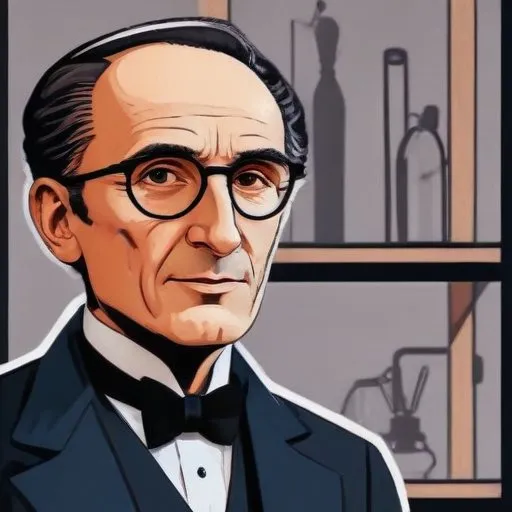
A French physicist and academic who made significant contributions to the study of light scattering and developed the Cabannes-Daure method, a technique used to measure the depolarization of light.
French physicist Jean Cabannes is renowned for his groundbreaking work in the realm of optics, particularly in the area of light diffusion and scattering. His extensive research and experimentation led to the discovery of the Cabannes-Daure effect, a phenomenon where gases diffusing monochromatic light can change their wavelength.
Born on August 12, 1885, in France, Cabannes pursued his higher education at the Lyce de Nice and later entered the prestigious cole Normale Suprieure in 1906. His academic foundation laid the groundwork for his future accomplishments in the field of physics.
Between 1910 and 1914, Cabannes worked alongside Charles Fabry at Aix-Marseille University, focusing on the diffusion of light by gas molecules – a concept introduced by Lord Rayleigh in the 19th century. In 1914, he demonstrated that pure gases could scatter light, a finding published in Comptes Rendus in 1915. Unfortunately, his career was temporarily halted due to World War I, during which he served for five years.
Following the war, Cabannes resumed his work in Fabry's laboratory, ultimately completing his thesis. He then moved on to the University of Montpellier and later to the University of Paris. In 1925, he collaborated with Jean Dufay to calculate the height of the ozone layer. Three years later, he, along with Pierre Daure and Yves Rocard, discovered the Cabannes-Daure effect, a finding that would change the face of optics.
Cabannes' impressive contributions to physics did not go unnoticed. In 1924, he received the Prix Flix-Robin, and in 1951, he was awarded the first-ever Prix des Trois Physiciens from the Fondation de France. Furthermore, he was elected a member of l'Acadmie des Sciences in 1949 and served as the President of the Socit astronomique de France from 1951 to 1953.
Cabannes was married to a daughter of Eugne Fabry, brother of Charles Fabry. He had four children, including the mathematician Henri Cabannes. The lunar crater Cabannes was named in his honor, a testament to his lasting impact on the scientific community.
Cabannes' work on light diffusion and scattering has far-reaching implications for various fields, including astronomy, atmospheric science, and materials science. His discoveries paved the way for future generations of scientists, influencing the development of new technologies and applications.
In the context of early 20th-century physics, Cabannes' work built upon the foundation laid by Lord Rayleigh and Charles Fabry. His contributions, alongside those of contemporaries like C. V. Raman and K. S. Krishnan, have had a lasting impact on our understanding of light and its interactions with matter.
While Cabannes left behind a wealth of scientific knowledge, his personal quotes and sayings are scarce. However, his dedication to the pursuit of scientific truth and his groundbreaking discoveries continue to inspire future generations of physicists and scientists.
Born in 1867
A pioneering scientist who pioneered radioactivity research, discovering elements polonium and radium, and paving the way for breakthroughs in medicine and energy.
Born in 1859
A pioneer in radioactivity research, discovering elements like polonium and radium, and pioneering radioactive isolation techniques. Their groundbreaking work paved the way for advancements in medicine, energy, and materials science.
Born in 1852
Discovered radioactivity, a fundamental property of atoms, and pioneered research in the field, leading to breakthroughs in medicine, energy, and materials science.
Born in 1879
A brilliant physicist who developed the theory of relativity and is considered one of the most influential scientists of the 20th century, known for his groundbreaking work in physics and mathematics.
Born in 1885
A pioneer in quantum mechanics, he introduced the concept of wave-particle duality, revolutionizing our understanding of atomic structure. His philosophical approach to science also explored the nature of reality and human understanding.
Born in 1901
A pioneer in quantum mechanics, he formulated the uncertainty principle, which revolutionized our understanding of the atomic world. His groundbreaking work reshaped modern physics.
Born in 1892
A French physicist and Nobel laureate who proposed that particles, such as electrons, can exhibit wave-like behavior, revolutionizing quantum mechanics. His hypothesis led to major breakthroughs in understanding the atomic structure.
