


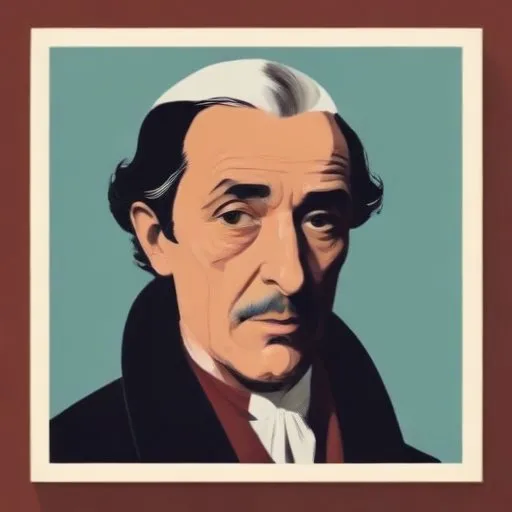
A 17th-century poet and critic who played a key role in establishing the French Academy and shaping the country's literary landscape through his influential writings and critiques.
Known as one of the pillars of the Grand Siècle, Jean Chapelain was a celebrated French poet and critic, renowned for his role as an organizer and founding member of the prestigious Académie Française. His literary prowess earned him considerable prestige, although his own major work, the epic poem La Pucelle, was not without its criticisms.
Born in Paris on December 4, 1595, Chapelain's early life was marked by his mother's influence, who had known the famous poet Pierre de Ronsard. She encouraged his literary pursuits, while his father wanted him to become a notary. Undeterred, Chapelain began learning Greek and Latin under Nicolas Bourbon and taught himself Italian and Spanish.
After completing his studies, Chapelain briefly taught Spanish to a young nobleman before becoming the tutor to the two sons of Sébastien Le Hardy, lord of la Trousse, grand prévôt de France. During this 17-year period, he acquired a reputation for his potential, although he published little.
Chapelain's first published work was a preface for Giambattista Marino's Adone, followed by a translation of Mateo Alemán's novel, Guzmán de Alfarache. He also wrote four odes, one of which was addressed to Cardinal Richelieu. This marked the beginning of his rise as a prominent literary figure.
Chapelain's most significant contribution was as a founding member of the Académie Française, established in 1635. He played a crucial role in shaping the institution's goals and objectives, earning him recognition as a literary critic and poet. His work, La Pucelle, an epic poem about Joan of Arc, although criticized by his contemporary Nicolas Boileau-Despréaux, remains a testament to his literary prowess.
Chapelain's legacy extends beyond his literary works. He was a key figure in shaping the French literary landscape of the 17th century, and his involvement in the Académie Française helped establish it as a revered institution. His work continues to inspire and influence literary critics and poets to this day.
Through his life's work, Chapelain left an indelible mark on French literature, cementing his place as a respected poet, critic, and founder of the Académie Française.
Born in 1636
A 17th-century French poet and critic who advocated for reason and morality in literature, and is known for his influential writings on poetry and aesthetics.
Born in 1639
A 17th-century master of French tragedy, crafting intricate, psychologically complex dramas that probed the human condition, influencing the development of Western theatre.
Born in 1622
A 17th-century master of comedy, he penned witty plays that satirized the French aristocracy, leaving a lasting impact on Western theater. His works remain widely performed and adapted today.
Born in 1606
A 17th-century French mastermind behind iconic plays like "Le Cid" and "Horace", known for pioneering the classical French tragedy genre.
Born in 1623
A 17th-century genius who made major contributions to mathematics, physics, and philosophy, inventing the mechanical calculator and developing the theory of probability. His writings also explored the human condition and faith.
Born in 1596
Developed influential philosophical and mathematical concepts, including the famous phrase "I think, therefore I am," and laid the foundation for modern Western philosophy.
Born in 1621
A 17th-century master of fables, crafting witty, moral tales that entertain and educate, still widely read and adapted today.
