


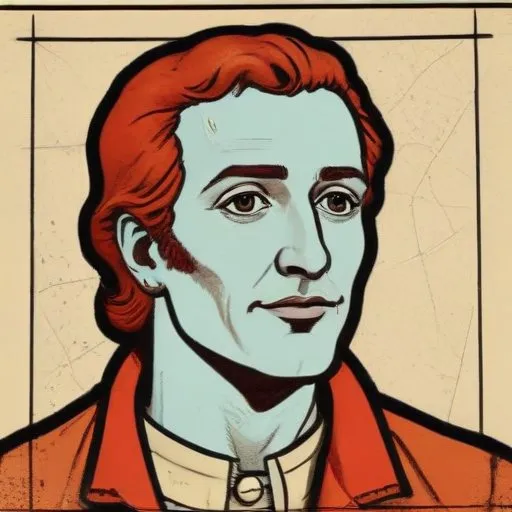
A 19th-century French polymath who explored Mesoamerica, creating detailed maps and illustrations of ancient ruins, and wrote extensively on his discoveries. His work remains a valuable resource for archaeologists and historians today.
Known for his extraordinary expeditions to Mexico and his controversial publication of the notorious I Modi, Jean-Frédéric Waldeck is a figure shrouded in mystery and intrigue. As an antiquarian, cartographer, artist, and explorer, Waldeck's life is marked by a trail of unverified claims, disputed accounts, and fascinating discoveries.
Waldeck's early life is a labyrinth of contradictions. He claimed to have been born in Paris, Prague, or Vienna, and at various times, asserted himself to be a German, Austrian, or British citizen. Moreover, he often used the title of count, duke, or baron, although these claims have never been verified.
Waldeck's passion for exploration took him to southern Africa at the age of 19, where he began his career as an adventurer. He later claimed to have returned to France and studied art under the tutelage of Jacques-Louis David, one of the most prominent artists of the Neoclassicist movement. Waldeck also alleged to have traveled to Egypt with Napoleon's expedition, although these claims remain unsubstantiated.
In the early 19th century, Waldeck published a series of drawings based on the infamous I Modi, a set of pornographic prints created by Marcantonio Raimondi in the 16th century. Accompanied by sonnets by Pietro Aretino, these prints had been deemed so explicit that Pope Clement VII ordered their destruction. Despite the controversy, Waldeck's publication brought I Modi back into the public eye, albeit with significant modifications.
Waldeck's most enduring legacy, however, stems from his exploration of Mexico and the publication of numerous examples of Maya and Aztec sculpture. Though his work sparked a renewed interest in Mesoamerican civilizations, it also perpetuated errors and misconceptions that would later contribute to the phenomenon of Mayanism.
In the midst of controversy, Waldeck's cartographic endeavors remain a testament to his boundless curiosity and dedication to discovery. His illustrations, though often inaccurate, provide a glimpse into the artistic and cultural landscape of 19th-century Mexico.
In the end, Waldeck's life remains a complex tapestry of truth and fabrication, genius and controversy. While his cartographic and artistic contributions continue to inspire and intrigue, his questionable claims and scandalous publications have cast a shadow over his legacy.
Born in 1769
A pioneering geographer and explorer who mapped much of South America and discovered the Caspian Sea's connection to the Black Sea, greatly advancing our understanding of the natural world.
Born in 1777
A pioneer in mathematics and physics, he made major contributions to number theory, algebra, and electromagnetism, shaping our understanding of the natural world.
Born in 1805
A French diplomat and engineer who developed the Suez Canal, a crucial waterway connecting the Mediterranean Sea to the Red Sea, revolutionizing global trade and commerce.
Born in 1780
A renowned French Neoclassicist painter and illustrator, celebrated for his exquisite portraits and historical scenes that epitomize elegance and refinement. His work continues to inspire artists and art enthusiasts alike.
Born in 1798
A Romantic-era master of expressive brushstrokes and vivid color, creating iconic works that captured the drama and emotion of historical and literary scenes.
Born in 1791
A Romantic-era master of dramatic and emotionally charged art, known for his powerful depictions of horses and the human experience.
Born in 1746
A visionary artist who pioneered Romanticism, capturing the human experience through bold, emotionally charged paintings and sculptures that continue to inspire and unsettle.
Born in 1717
A pioneer in art history and archaeology, he's credited with founding the discipline of art history and shaping our understanding of ancient Greek and Roman art and culture.
