


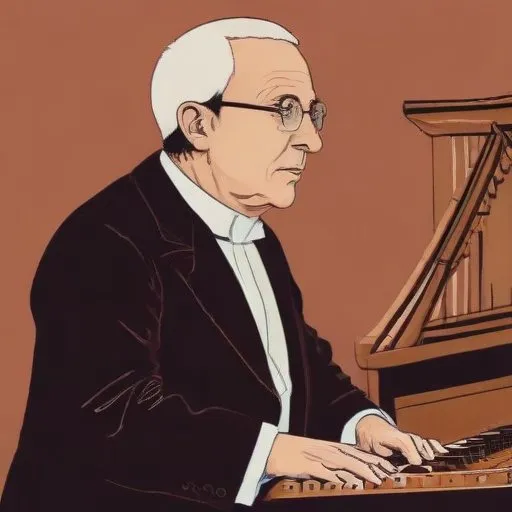
A renowned 17th-century French Baroque composer and organist, known for his intricate and expressive harpsichord pieces, particularly his transcriptions of Lully's operas. He was also a prominent teacher and performer at the Royal Chapel in Versailles.
JeanHenri d'Anglebert is widely regarded as one of the most influential harpsichordists and composers of the 17th century, leaving an indelible mark on the French Baroque genre. His intricate and ornate compositions, characterized by complex harmonies and virtuosic passages, continue to inspire and challenge musicians to this day.
Although little is known about d'Anglebert's early years, it is believed that he received his musical education from the renowned composer and harpsichordist, Jacques Champion de Chambonnières. This mentorship would have a profound impact on d'Anglebert's development as a composer, as evidenced by the numerous homages to Chambonnières throughout his oeuvre.
d'Anglebert's talents were first recognized in the mid-1650s, when his compositions began to circulate among the Parisian musical elite. His earliest surviving manuscript, dating from 1650-1659, features works by prominent composers of the time, including Louis Couperin and Chambonnières, indicating his close association with the leading figures of the French Baroque.
In 1659, d'Anglebert married Magdelaine Champagne, sister-in-law of the prominent organist Franois Roberday. This marriage contract, which describes d'Anglebert as a bourgeois de Paris, suggests that he had already established himself as a respected musician in the city.
d'Anglebert's career in Paris began at the Jacobins church in Rue St. Honor, where he served as organist from 1660. He soon caught the attention of Philippe I, Duke of Orléans, brother of King Louis XIV, who appointed him harpsichordist in 1660. d'Anglebert would go on to hold this position until at least 1668, solidifying his reputation as a master of the harpsichord.
d'Anglebert's compositions, characterized by their technical complexity and lyricism, span a range of genres, including suites, fugues, and tombeaux. His music, often described as introspective and contemplative, continues to be celebrated for its beauty and emotional depth.
Among his most notable works are his harpsichord suites, which showcase his innovative use of ornamentation and counterpoint. These suites, often featuring unconventional harmonies and surprising modulations, are a testament to d'Anglebert's bold and pioneering spirit.
d'Anglebert's influence on the development of Western classical music cannot be overstated. His compositions, which blended French and Italian elements, paved the way for future generations of composers, including the likes of François Couperin and Jean-Philippe Rameau.
Today, d'Anglebert's music remains a staple of harpsichord repertoire, with countless recordings and performances paying tribute to his enduring legacy. His contributions to the French Baroque, marked by innovation, creativity, and technical mastery, continue to inspire and captivate audiences around the world.
JeanHenri d'Anglebert may have lived in the shadow of his more famous contemporaries, but his music and legacy continue to shine brightly, a testament to his innovative spirit and artistic genius.
Born in 1683
A prominent figure in the Baroque period, this composer and theorist revolutionized Western classical music with innovative harmonies and treatises on music theory, shaping the course of classical music.
Born in 1668
A renowned Baroque composer and organist, known for his intricate and expressive harpsichord music that showcased his mastery of counterpoint and ornamentation. His works continue to inspire and influence classical music today.
Born in 1672
A renowned Baroque-era organist and composer, known for his innovative and expressive organ music, particularly his "Livre d'Orgue" which showcased his mastery of the instrument.
Born in 1694
A renowned Baroque composer and organ virtuoso, known for his innovative and expressive harpsichord pieces, particularly his "Cuckoo and Nightingale" composition.
Born in 1707
A renowned French Baroque musician and writer, known for composing numerous operas, oratorios, and instrumental works, as well as authoring influential music theory books.
Born in 1712
A pioneering thinker who shaped modern democracy and education with his ideas on social contracts, general will, and the importance of early childhood education. His writings influenced the French Revolution and modern political thought.
Born in 1714
A pioneering opera composer who revolutionized the art form with his innovative and expressive works, blending music and drama in a way that captivated audiences.
Born in 1660
A French Baroque composer and conductor, known for his sacred music and operas that blended Italian and French styles. He was a prominent figure in French music during the early 18th century.
