


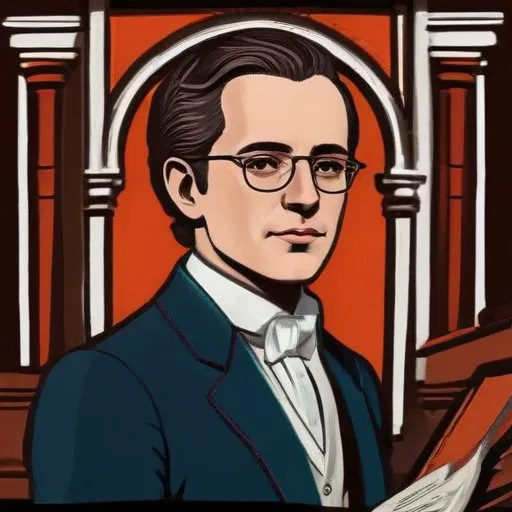
A renowned Baroque composer and organ virtuoso, known for his innovative and expressive harpsichord pieces, particularly his "Cuckoo and Nightingale" composition.
Louis-Claude Daquin was a French composer and virtuoso organist, renowned for his mastery of the Baroque and Galant styles. Born on July 4, 1694, in Paris, Daquin was a child prodigy who performed for the court of Louis XIV at the tender age of six.
Daquin's family originated from Italy, where his great-great-grandfather took the name D'Aquino after converting to Catholicism in the town of Aquino. His parents, Claude Daquin, a painter, and Anne Tiersant, a grandniece of Rabelais, nurtured his musical talent from an early age. Daquin's granduncles were a professor of Hebrew at the Collège de France and the principal physician of King Louis XIV, respectively, indicating the family's strong connections to the French royal court.
At the age of 12, Daquin became the organist at the Sainte-Chapelle, and in the following year, he took a similar post at the Church of Petit Saint Antoine. He studied under the renowned organist Louis Marchand, who recognized Daquin's exceptional talent. In 1722, he married Denise-Thérèse Quirot, and his career continued to flourish.
Daquin's compositions include four harpsichord suites, the c. 1757 Nouveau livre de noëls for organ and harpsichord settings of Christmas carols, which showcase his harpsichord improvisations. He also wrote a cantata and an air. Daquin's music was characterized by its complexity, intricacy, and technical virtuosity, reflecting his exceptional skill as a performer.
As a performer, Daquin was known for his unfaltering precision and evenness at both the harpsichord and organ. His concerts drew large crowds, and he was courted by the aristocracy for his exceptional talent. In 1739, he became the organist to King Louis XV at the Chapelle Royale, a testament to his stature in the French musical scene.
Daquin's legacy as a composer and organist continues to inspire and influence generations of musicians. His music, characterized by its technical complexity and virtuosity, has contributed significantly to the development of the Baroque and Galant styles. As a performer, Daquin's exceptional skill and precision set a new standard for organists and harpsichordists.
In conclusion, Louis-Claude Daquin was a remarkable figure in the world of music, whose exceptional talent, technical virtuosity, and contributions to the Baroque and Galant styles have left an indelible mark on the history of classical music.
Born in 1683
A prominent figure in the Baroque period, this composer and theorist revolutionized Western classical music with innovative harmonies and treatises on music theory, shaping the course of classical music.
Born in 1668
A renowned Baroque composer and organist, known for his intricate and expressive harpsichord music that showcased his mastery of counterpoint and ornamentation. His works continue to inspire and influence classical music today.
Born in 1629
A renowned 17th-century French Baroque composer and organist, known for his intricate and expressive harpsichord pieces, particularly his transcriptions of Lully's operas. He was also a prominent teacher and performer at the Royal Chapel in Versailles.
Born in 1665
A pioneering female composer of the Baroque period, known for her innovative and expressive harpsichord music that blended French and Italian styles.
Born in 1660
A French Baroque composer and conductor, known for his sacred music and operas that blended Italian and French styles. He was a prominent figure in French music during the early 18th century.
Born in 1632
A 17th-century mastermind who revolutionized French opera, creating lavish productions that captivated the royal court and beyond. He's credited with establishing the French opera tradition.
Born in 1714
A pioneering opera composer who revolutionized the art form with his innovative and expressive works, blending music and drama in a way that captivated audiences.
