


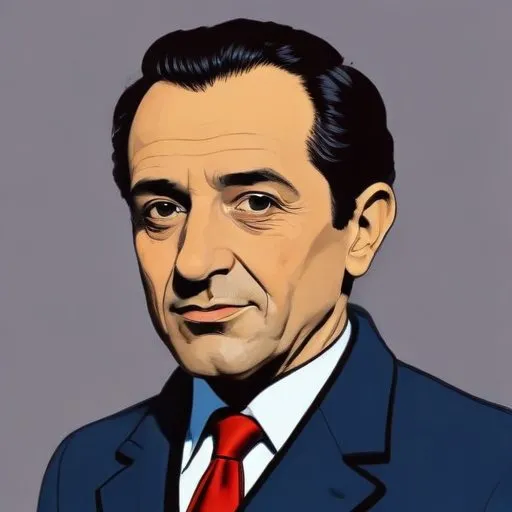
French author and activist who fought against racism and anti-Semitism, particularly during World War II, and was a key figure in the French Resistance.
Jean Pierre-Bloch, a French Resistant of the Second World War, is renowned for his courageous efforts in fighting against racism and anti-Semitism. As a former president of the International League against Racism and Anti-Semitism, Bloch dedicated his life to promoting human rights and combating discrimination in all its forms.
Born on April 14, 1905, to an industrialist family, Bloch's early life was marked by a strong sense of social justice. He received a law degree from the Sorbonne and soon became involved in socialist politics, joining the SFIO (French Section of the Workers' International) in the late 1920s.
As a journalist for Populaire, the daily newspaper of the socialist party, Bloch's writing became a powerful tool for promoting his political ideologies. His activism soon led him to hold various political positions, including general councilor for the Aisne department and adjunct to the mayor of Laon.
In 1936, Bloch became the youngest deputy in the French National Assembly, a position that gave him a platform to speak out against the growing threat of fascism. In 1938, he was one of the few parliamentarians to oppose the Munich Agreement, a decision that would ultimately pave the way for Germany's invasion of Czechoslovakia.
As a Jew, Bloch was acutely aware of the dangers posed by Hitler's regime. When war broke out in 1939, he enlisted voluntarily and was later made a prisoner of war in 1940. While in captivity, he rearranged the hyphen in his name, a gesture of defiance in the face of oppression.
After escaping from prison, Bloch joined the internal Resistance in Dordogne and worked closely with his wife, Gaby, to arrange parachute drops of agents, arms, and equipment sent by de Gaulle's headquarters in London.
Arrested again in Marseille in 1941, Bloch was imprisoned on treason charges. His wife, however, managed to send him hidden parcels containing saws, keys, and money, which enabled him to escape in July 1942.
Joining General de Gaulle in London, Bloch headed the civilian section of the central bureau of intelligence and action (BCRA), the secret services of Free France, from 1942 to 1943. This position gave him access to the names of all resistants, making him a key witness at Maurice Papon's trial after the war.
Throughout his life, Jean Pierre-Bloch remained committed to fighting against racism and anti-Semitism. As president of the International League against Racism and Anti-Semitism, he worked tirelessly to promote human rights and combat discrimination in all its forms.
Bloch's bravery and conviction have inspired generations of activists and human rights defenders. His legacy serves as a powerful reminder of the importance of standing up against oppression and discrimination, and his story continues to inspire us today.
Today, Jean Pierre-Bloch's story serves as a testament to the power of courage and conviction in the face of overwhelming oppression. His legacy continues to inspire us to stand up against racism, anti-Semitism, and discrimination in all its forms.
Born in 1905
Existentialist philosopher and playwright who argued that humans have complete freedom to choose their actions and create their own meaning in life, influencing modern thought on morality and individual responsibility.
Born in 1908
A pioneering feminist philosopher who wrote extensively on ethics, politics, and gender, famously arguing that "one is not born, but rather becomes, a woman."
Born in 1913
A French novelist, philosopher, and journalist who wrote influential works like "The Stranger" and "The Plague", exploring absurdism and the human condition.
Born in 1889
A German philosopher and academic who explored the meaning of existence, time, and human existence, influencing 20th-century philosophy with his concept of "Being-in-the-world".
Born in 1924
A French philosopher, sociologist, and literary theorist who challenged traditional notions of knowledge, truth, and power, and is famous for his concept of "postmodernism".
Born in 1915
A French philosopher, theorist, and critic who challenged traditional notions of culture, literature, and identity through his influential writings on semiotics, mythology, and structuralism. He's most known for his critical theories on modern society and culture.
99 Years Old
A French historian and philosopher who critiqued power structures and social norms, arguing that knowledge and truth are shaped by those in power. He's known for his concepts of power, discipline, and surveillance.
Born in 1925
A French philosopher who developed influential concepts like "rhizome" and "desire-machines," which challenged traditional notions of identity, reality, and power.
