


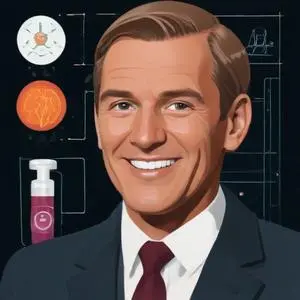
Discovered the sodium-potassium pump, a crucial mechanism for nerve and muscle function, earning the Nobel Prize in Chemistry in 1997. This groundbreaking finding has far-reaching implications for our understanding of cellular biology.
Jens Christian Skou, a renowned Danish biochemist, is best known for his groundbreaking discovery of the Na,K-ATPase, a crucial enzyme that regulates the transport of sodium and potassium ions across cell membranes. This pioneering work earned him the Nobel Prize in Chemistry in 1997, alongside Paul D. Boyer and John E. Walker.
Born on October 8, 1918, in Lemvig, Denmark, Skou came from a wealthy family. His father, Magnus Martinus Skou, was a successful timber and coal merchant, while his mother, Ane Margrethe Skou, took over the company after her husband's passing. Skou's academic journey began at the age of 15, when he entered a boarding school in Haslev, Zealand. He later graduated in medicine from the University of Copenhagen in 1944 and received his doctorate in 1954.
Skou's academic career took off in 1947, when he joined Aarhus University. He was appointed professor of biophysics in 1977 and continued to work at the university until his retirement in 1988. However, he maintained an office at the Department of Physiology (now part of the Department of Biomedicine) and remained actively involved in research.
Skou's research focus shifted in the early 1950s, when he took a break from his clinical training to study the action of local anesthetics. His findings led him to explore the relationship between anesthetics and the plasma membrane, specifically the sodium channels. This work laid the foundation for his discovery of Na,K-ATPase.
Skou's Nobel Prize-winning discovery was the result of his work on the enzyme ATPase in crab nerves. He observed that local anesthetics affected the enzyme's properties, leading him to investigate further. By studying the effects of anesthetics on ATPase, Skou identified the Na,K-ATPase, a crucial enzyme responsible for maintaining the balance of sodium and potassium ions across cell membranes.
Jens Christian Skou's discovery of Na,K-ATPase has had a profound impact on our understanding of cellular processes and the regulation of ion transport. His work has paved the way for further research into cellular biology, neuroscience, and pharmacology. As a pioneer in his field, Skou's contributions continue to inspire and influence scientists worldwide.
Skou passed away on May 28, 2018, leaving behind a legacy of groundbreaking research and discovery. Throughout his life, he remained dedicated to his work, driven by a passion for understanding the intricacies of cellular biology.
Skou's story serves as a testament to the power of dedication, perseverance, and curiosity. His remarkable journey from a young boy in Denmark to a Nobel laureate inspires future generations of scientists to strive for excellence and push the boundaries of human knowledge.
Born in 1920
A British biochemist who discovered the mechanism of cellular respiration, earning a Nobel Prize in Chemistry for his groundbreaking work on the electron transport chain. His research revolutionized our understanding of energy production in cells.
Born in 1898
A high-ranking officer in the German Wehrmacht during World War II, known for his involvement in the July 20 plot to assassinate Adolf Hitler.
Born in 1900
A Finnish-Swedish physiologist who discovered the workings of the retina and developed the concept of receptive fields, earning him the Nobel Prize in Physiology or Medicine in 1967. His work laid the foundation for modern neuroscience and visual perception research.
Born in 1905
A Swedish physiologist and academic who discovered neurotransmitters, specifically noradrenaline, and its role in the nervous system, earning him a Nobel Prize in Physiology or Medicine in 1970.
Born in 1887
A pioneering physiologist who discovered the role of pituitary hormones in regulating blood sugar levels, earning him a Nobel Prize in Physiology or Medicine. His work laid the foundation for modern endocrinology.
Born in 1918
Pioneering biochemist who discovered the mechanism of DNA replication and was awarded the Nobel Prize in Physiology or Medicine in 1959 for his groundbreaking work on nucleic acid synthesis.
