


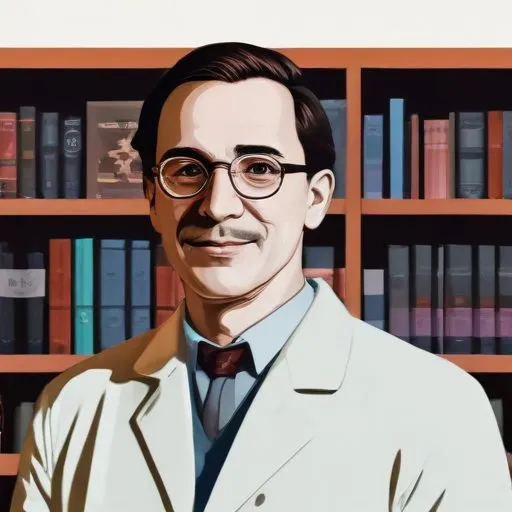
Developed the first successful antiretroviral drug, AZT, to treat HIV/AIDS, revolutionizing the treatment of the disease. His work saved countless lives and paved the way for modern HIV treatment.
Jerome Horwitz, an American scientist, is best known for his groundbreaking discovery of zidovudine (AZT), an antiviral drug used to treat HIV patients. His work has had a profound impact on the lives of millions, revolutionizing the treatment of HIV and AIDS.
Jerome Horwitz was born on January 16, 1919, in Detroit, Michigan, to a Jewish family. He graduated from Central High School in 1937 and went on to earn his bachelor's and master's degrees in chemistry from the University of Detroit.
He later pursued his doctorate in chemistry from the University of Michigan, followed by postdoctoral training at Northwestern University and the University of Michigan.
In 1964, while conducting research for the Michigan Cancer Foundation, Horwitz synthesized AZT, initially developed as a treatment for cancer. This breakthrough discovery led to the development of other reverse transcriptase inhibitors, including stavudine (d4T) and zalcitabine (ddC).
Horwitz's work did not stop there. He also published the first production and demonstration of X-gal as a chromogenic substrate in 1964.
Throughout his career, Horwitz worked with various institutions, including the Barbara Ann Karmanos Cancer Institute and the Wayne State University School of Medicine. His research focused on developing treatments for cancer and other diseases.
In his later years, Horwitz worked on several projects funded by the National Institutes of Health, leading to significant advancements in the field of medicine.
Horwitz's discovery of AZT has had a profound impact on the lives of millions of people living with HIV and AIDS. His work has enabled patients to manage their condition and live longer, healthier lives.
His contributions have also paved the way for further research and development of treatments for HIV and AIDS, inspiring a new generation of scientists and researchers.
In 2005, Horwitz retired from his position at the Michigan Cancer Foundation, leaving behind a legacy of groundbreaking research and discovery.
He was featured in the documentary film "I Am Alive Today: The Story of an AIDS Drug," which highlighted his work and contributions to the field of medicine.
Jerome Horwitz's work has been recognized and celebrated through various awards and honors. His legacy continues to inspire and influence the scientific community, leaving a lasting impact on the world of medicine.
In conclusion, Jerome Horwitz's groundbreaking discovery of AZT has had a profound impact on the lives of millions of people living with HIV and AIDS. His work and legacy serve as a testament to the power of dedication, perseverance, and innovation in the pursuit of medical breakthroughs.
Horwitz's story is a reminder that the work of dedicated scientists and researchers can change the world, one discovery at a time.
Born in 1918
Pioneering biochemist who discovered the mechanism of DNA replication and was awarded the Nobel Prize in Physiology or Medicine in 1959 for his groundbreaking work on nucleic acid synthesis.
Born in 1905
A pioneering biochemist who discovered the mechanism of RNA synthesis, earning a Nobel Prize in Physiology or Medicine in 1959. His work laid the foundation for our understanding of genetic code and protein synthesis.
Born in 1911
A pioneering chemist who uncovered the secrets of photosynthesis, earning a Nobel Prize for his groundbreaking work on the carbon dioxide assimilation process in plants.
Born in 1913
A pioneer in protein chemistry, he discovered the first amino acid sequence of an enzyme, revolutionizing our understanding of biological processes. His work paved the way for major advancements in biochemistry and medicine.
Born in 1911
A Nobel Prize-winning chemist and biologist who discovered the structure of ribonuclease, a key enzyme involved in protein synthesis, and contributed significantly to our understanding of biological molecules. Their work has far-reaching implications for medicine and genetics.
Born in 1893
A pioneering scientist who discovered deuterium, a heavy isotope of hydrogen, and later contributed to the discovery of many other elements, revolutionizing our understanding of the universe.
Born in 1898
A high-ranking officer in the German Wehrmacht during World War II, known for his involvement in the July 20 plot to assassinate Adolf Hitler.
