


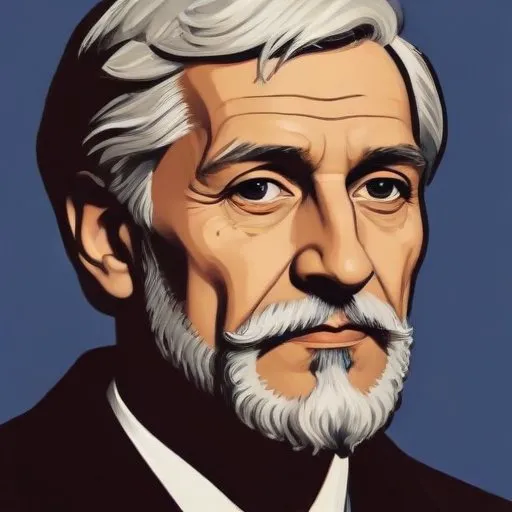
A 17th-century polymath who made significant contributions to mathematics, philosophy, and logic, laying the groundwork for modern scientific thought. His work on combinatorics and probability theory was particularly influential.
Joachim Jungius was a German mathematician, logician, and philosopher of science who left an indelible mark on the scientific community of the 17th century. He is best known for his pioneering work in atomism, corpuscular chemistry, and his groundbreaking textbook on logic, Logica Hamburgensis.
Born in Lübeck, Germany in 1587, Jungius pursued his passion for knowledge with unrelenting fervor. He studied metaphysics at the Universities of Rostock and Giessen, earning his degree in 1608.
Jungius held various professorial positions throughout his career, including stints as professor of mathematics at Rostock (1624-1628) and professor of natural sciences at the Akademisches Gymnasium in Hamburg (1629-1657).
During his tenure in Hamburg, he emphasized the importance of critical thinking and mathematical rigor to his students, rebelling against metaphysical and mystical speculation.
Jungius was a vocal advocate of corpuscular chemistry, which assumed the conservation of mass. He also demonstrated that a catenary was not a parabola, a significant mathematical discovery of his time.
His magnum opus, Logica Hamburgensis, published in 1638, presented late medieval theories and techniques of logic. This influential textbook showcased oblique cases of arguments that did not adhere to simpler forms of inference.
Jungius's work had a profound impact on the development of science in the 17th century. His emphasis on mathematical rigor and critical thinking paved the way for future generations of scientists.
Through his contributions to atomism and corpuscular chemistry, Jungius helped lay the groundwork for the scientific revolution of the 17th century.
Today, Joachim Jungius is remembered as a towering figure in the history of science, a true polymath whose work continues to inspire and influence scholars around the world.
Born in 1596
Developed influential philosophical and mathematical concepts, including the famous phrase "I think, therefore I am," and laid the foundation for modern Western philosophy.
Born in 1632
A 17th-century philosopher and scholar who developed a comprehensive philosophical system that emphasizes God, nature, and human freedom, influencing modern thought on ethics, politics, and religion.
Born in 1646
Developed calculus independently of Isaac Newton, and made major contributions to the fields of philosophy, politics, and history.
Born in 1592
A 17th-century polymath who made significant contributions to the scientific revolution, merging ancient Greek philosophy with modern scientific methods, and providing a foundation for modern astronomy. He's also known for his work on the concept of the vacuum and the behavior of gases.
Born in 1588
A 17th-century polymath who made significant contributions to mathematics, particularly in the discovery of prime numbers, and wrote extensively on philosophy and theology.
Born in 1629
A 17th-century polymath who made groundbreaking contributions to optics, probability theory, and astronomy, including the discovery of Saturn's rings and the largest moon, Titan.
Born in 1632
Pioneering microbiologist who discovered microorganisms like bacteria, yeast, and protists, laying the foundation for modern microbiology.
Born in 1571
A 17th-century trailblazer who discovered the three laws of planetary motion, revolutionizing our understanding of the solar system. He's also credited with being a pioneer in the field of astrology.
