


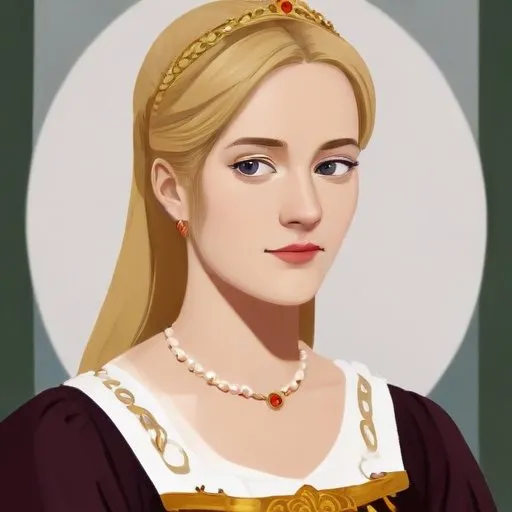
Ruling Duchess of Brabant from 1356 to 1406, known for her diplomatic and military skills, which helped maintain peace and stability in the region.
Known as the Duchess of Brabant from 1355 until her death in 1406, Joanna, Duchess of Brabant, left an indelible mark on the history of medieval Europe. She was a pioneering ruler who played a significant role in shaping the course of her duchy, navigating complex alliances, and defending her territories against rival claims.
Born on 24 June 1322, Joanna was the daughter of John III, Duke of Brabant, and Marie d'Évreux. Her early life was marked by two significant marriages. In 1334, she married William II, Count of Hainaut, who died in battle, leaving her a widow at a young age. Her only son, William, died young, thwarting the plan to unify their territories.
Her second marriage to Wenceslaus of Luxemburg proved to be a turning point in her life. This union brought her into the orbit of the powerful Luxembourg dynasty, which would have far-reaching consequences for her duchy.
In January 1356, Joanna and her consort signed the famous Blijde Inkomst (Joyous Entry), a document that established the rule of law in Brabant and secured peaceable entry into their capital. This historic agreement was intended to settle the inheritance of the Duchy of Brabant on her natural heirs, her sisters, who were preferred by the burghers of Brabant over the rule of the House of Luxembourg.
However, the Blijde Inkomst was soon undermined by the military incursion of Louis II of Flanders, who had married Margaret, Joanna's younger sister, and claimed the title of Duke of Brabant by right of his wife. The Duchy was overrun by Louis' forces, and Joanna and Wenceslaus were forced to sign the humiliating Treaty of Ath, which ceded Mechelen and Antwerp to Louis.
Despite the challenges she faced, Joanna's determination and resilience ensured that her legacy endured. At the time of her death in 1406, the rights to the Duchy of Brabant passed to her great-nephew, Anthony of Burgundy, son of Philip the Bold. Her story serves as a testament to the complexities of medieval politics and the tenacity of a ruler who fought to protect her territory and her people.
Joanna's legacy extends beyond her own lifetime. Her struggles to maintain power and defend her territory reflect the complexities of medieval politics, providing valuable insights for historians and scholars today. Her story serves as a reminder of the importance of strong leadership and determination in the face of adversity.
Born in 1403
Duke of Brabant who ruled from 1415 to 1427 and was a member of the House of Valois-Burgundy, known for his attempts to centralize power and strengthen his duchy's economy.
Born in 1504
A German nobleman who ruled Hesse from 1509 to 1567, known for being a champion of the Protestant Reformation and a key figure in the Schmalkaldic League.
Born in 1403
Duke of Brabant who ruled from 1415 to 1427 and was a member of the House of Valois-Burgundy, known for his attempts to centralize power and strengthen his duchy's economy.
Born in 1276
A 13th-century Duchess of Brabant, known for her diplomatic skills and strategic marriages that shaped the region's politics. She played a crucial role in maintaining peace and stability in the Low Countries.
Born in 1275
A 14th-century nobleman who ruled Brabant, a region in modern-day Belgium, and is remembered for his military campaigns and territorial expansions. He strengthened the duchy's economy and fostered a cultural Renaissance.
