


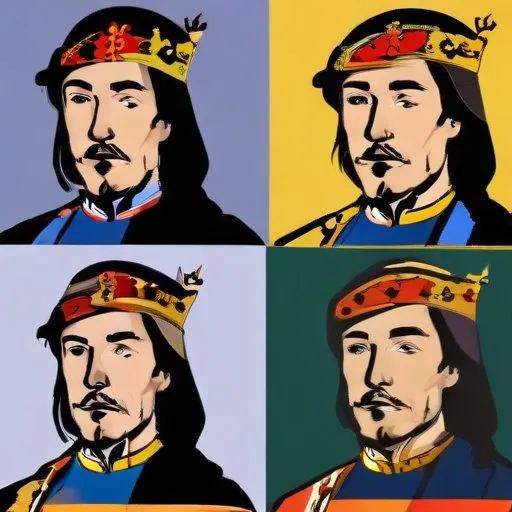
A 14th-century nobleman who ruled Brabant, a region in modern-day Belgium, and is remembered for his military campaigns and territorial expansions. He strengthened the duchy's economy and fostered a cultural Renaissance.
John II, Duke of Brabant, also known as John the Peaceful, is renowned for his visionary leadership and unwavering commitment to defending his duchy against French expansion during the late 13th century. As the ruler of Brabant, Lothier, and Limburg from 1294 to 1312, John II left an indelible mark on medieval history, earning him a revered place among his contemporaries and successors.
Born on September 27, 1275, John II was the son of John I of Brabant and Margaret of Flanders. Following his father's footsteps, John II succeeded him in 1294, inheriting the responsibilities of governing the duchy. During his reign, John II demonstrated exceptional diplomatic skills, forging crucial alliances to counter the growing French threat.
One of John II's most notable achievements was his determination to protect Brabant from French aggression. He formed a coalition with neighboring regions to resist French expansion, demonstrating his commitment to the welfare and security of his people. Although his attempts to conquer South Holland from the pro-French Count John II of Holland were unsuccessful, John II's unwavering resolve earned him respect and admiration from his contemporaries.
In 1309, the Crusade of the Poor besieged the castle of Genappe in Brabant, seeking to persecute Jews who had taken refuge there. John II responded swiftly, sending an army that defeated the crusaders, inflicting heavy losses on them. This crucial victory cemented John II's reputation as a protector of his people, regardless of their faith or background. Later, in 1312, John II signed the celebrated Charter of Kortenberg, a milestone document that paved the way for a peaceful transition of power to his son upon his death.
On July 8, 1290, John II married Margaret of England, daughter of King Edward I of England and Eleanor of Castile, in Westminster Abbey, London. Their union produced one son, John III, Duke of Brabant. John II also had several illegitimate children, including Jan van Corsselaer, Jan van Wyvliet, and Jan Cordeken, who went on to play significant roles in shaping the history of Brabant.
John II died on October 27, 1312, in Tervuren, and was laid to rest in the St. Michael and Gudula Cathedral in Brussels. His leadership, marked by wisdom, courage, and compassion, has left an enduring legacy, inspiring generations to come.
John II, Duke of Brabant, remains an iconic figure in medieval history, celebrated for his unwavering commitment to his people and his duchy. His remarkable leadership, marked by wisdom, courage, and compassion, continues to inspire and fascinate historians and enthusiasts alike.
Born in 1275
A 14th-century nobleman who ruled Brabant, a region in modern-day Belgium, and is remembered for his military campaigns and territorial expansions. He strengthened the duchy's economy and fostered a cultural Renaissance.
Born in 1404
A 14th-century nobleman who ruled Brabant, a region in modern-day Belgium, and was a key figure in the Hundred Years' War between England and France. He's known for his military prowess and strategic alliances.
Born in 1433
The last Valois Duke of Burgundy, he unified the Burgundian territories and fought to create a kingdom, leaving a legacy of cultural and economic achievements. His ambitions and military campaigns shaped European politics and history.
Born in 1457
Sovereign Duchess regnant of Burgundy, married to Maximilian I, Holy Roman Emperor, who ruled Burgundy and played a crucial role in shaping European politics and history through her marriage and alliances. She's also known for her cultural and artistic patronage.
Born in 1459
First Holy Roman Emperor to rule simultaneously as King of the Romans and King of Spain, known for uniting fragmented German states and establishing the Habsburg dynasty.
Born in 1500
Ruling over a vast empire from 1519 to 1556, he was a powerful and influential leader who played a crucial role in shaping European politics and religion. He is most known for his efforts to unify Christian Europe and defend it against the Ottoman Empire.
