


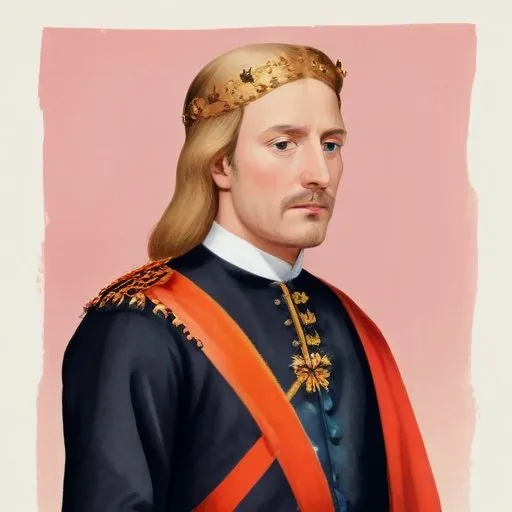
Duke of Brabant who ruled from 1415 to 1427 and was a member of the House of Valois-Burgundy, known for his attempts to centralize power and strengthen his duchy's economy.
John IV, Duke of Brabant, was a trailblazing figure in medieval Europe, best known for founding the University of Louvain (Leuven) in 1425, one of the oldest and most prestigious universities in Europe. This remarkable institution would go on to become a beacon of knowledge and scholarship, shaping the minds of future generations.
John IV was born on June 11, 1403, in Arras, the son of Antoine of Burgundy, Duke of Brabant, Lothier, and Limburg, and his first wife Jeanne of Saint-Pol. He succeeded his father as Duke of Brabant in 1415, following his father's death at the Battle of Agincourt. However, his succession was not without controversy, as the Holy Roman Emperor Sigismund contested his claim, seeking to curb the Valois influence in the region.
John IV's uncle, John the Fearless, Duke of Burgundy, came to his nephew's aid, supporting his claim to the dukedom. The States of Brabant also rallied behind John IV, and their joint support prevented a second succession war in the duchy. As a result, the States of Brabant gained regency over the duchy until John IV came of age.
In 1418, John IV married Jacqueline, Countess of Hainaut, in a union that aimed to provide a protector for her inheritance against the claims of her uncle, John III. Through their marriage, the counties of Holland, Zeeland, and Hainaut, and the duchies of Brabant and Limburg were united in a personal union. However, the marriage ultimately led to estrangement in 1420, largely due to John IV's inability to protect Jacqueline's rights in Holland and Zeeland.
John IV's most enduring legacy is the founding of the University of Louvain (Leuven) in 1425. This momentous event marked a significant milestone in the history of education, as it became one of the oldest and most respected institutions of higher learning in Europe. The university would go on to attract scholars from across the continent, fostering a culture of intellectual curiosity and scholarly excellence.
John IV's reign was marked by a complex web of alliances, power struggles, and marital intrigues. Despite these challenges, he managed to leave a lasting impact on the region, particularly through the founding of the University of Louvain. His legacy serves as a testament to the enduring power of education and the importance of fostering knowledge and intellectual curiosity.
John IV's remarkable life and legacy continue to inspire and captivate historians and scholars to this day, offering a fascinating glimpse into the complex world of medieval politics, power struggles, and intellectual pursuits.
John IV's life was marked by significant events that shaped his reign and legacy. His marriage to Jacqueline, Countess of Hainaut, and the founding of the University of Louvain are two of the most notable milestones in his life. Despite facing numerous challenges, John IV managed to leave a lasting impact on the region and the world of education.
Born in 1433
The last Valois Duke of Burgundy, he unified the Burgundian territories and fought to create a kingdom, leaving a legacy of cultural and economic achievements. His ambitions and military campaigns shaped European politics and history.
Born in 1457
Sovereign Duchess regnant of Burgundy, married to Maximilian I, Holy Roman Emperor, who ruled Burgundy and played a crucial role in shaping European politics and history through her marriage and alliances. She's also known for her cultural and artistic patronage.
Born in 1478
The King of Castile and ruler of Burgundy, known for his lavish spending and cultural achievements, including the construction of the Palace of Coudenberg in Brussels.
Born in 1643
A 17th-century nobleman who ruled Lorraine and played a significant role in the Thirty Years' War, known for his military campaigns and territorial expansions.
Born in 1397
Queen consort of Spain, married to Charles V, and a skilled politician who played a crucial role in governing the empire during her husband's absences. She was a patron of the arts and a strong supporter of the Spanish Inquisition.
