


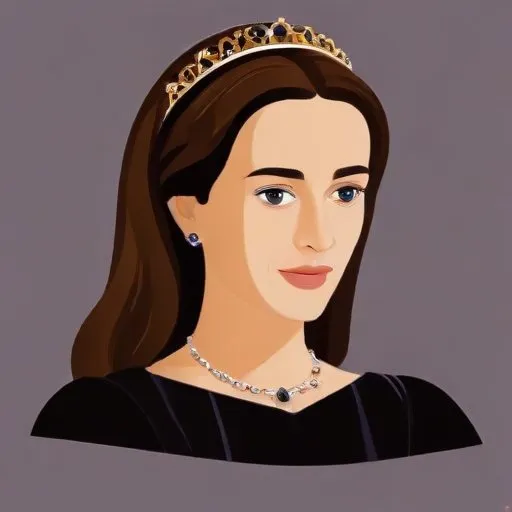
Daughter of King Afonso V of Portugal, she was a royal who played a significant role in the country's politics and was known for her strong will and diplomatic skills. She was also a patron of the arts and education.
Joanna, Princess of Portugal, is revered for her unwavering dedication to her faith and her remarkable stint as regent during her father's absence in 1471. This extraordinary woman's life was marked by her struggle to balance her royal duties with her deep-seated desire to devote herself to a life of spirituality.
Joanna was born on February 6, 1452, to King Afonso V of Portugal and his first wife, Isabel of Coimbra. As the second child, she was initially recognized as heir presumptive and granted the title of Princess of Portugal. However, with the birth of her younger brother, the future John II of Portugal, in 1455, she ceased to be the heir apparent.
In 1471, Joanna served as regent during her father's military expedition to Tangier. This period showcased her administrative prowess and leadership skills, earning her the respect of her people. Despite her success, Joanna's heart remained committed to a life of faith, and she longed to enter a convent.
In 1475, Joanna joined the Dominican Convent of Jesus in Aveiro, where she could finally pursue her spiritual aspirations. Her devotion to her faith was unwavering, and she rejected several marriage proposals, including those from Charles VIII of France and Richard III of England.
Joanna's remarkable life and dedication to her faith have earned her a revered place in Portuguese history. She is venerated in the Catholic Church and commonly known as Princess Saint Joan (Santa Joana Princesa). Her saintly reputation continues to inspire generations, cementing her status as a beloved and iconic figure in Portugal.
Joanna's life serves as a testament to the complexities of royal duties and personal aspirations during the 15th century. Her struggles to balance her faith with her royal obligations reflect the societal expectations placed upon women of nobility during that era. In comparison to her contemporaries, Joanna's unwavering commitment to her faith sets her apart as a remarkable and trailblazing figure.
Joanna's life is a testament to the power of devotion and perseverance. Her story serves as a reminder that one's personal aspirations can coexist with their duties, and that faith can be a guiding force in the face of adversity.
Joanna, Princess of Portugal, leaves behind a legacy of faith, duty, and devotion, inspiring generations to come. Her remarkable story serves as a testament to the power of human spirit and the importance of following one's heart, even in the face of adversity.
Born in 1455
King of Portugal from 1481 to 1495, known for his centralizing policies, establishing a strong monarchy, and sponsoring explorers like Bartolomeu Dias and Vasco da Gama.
Born in 1432
King of Portugal who ruled from 1438 to 1481, known for his military conquests in North Africa and the expansion of Portuguese trade and exploration.
Born in 1320
King of Portugal who ruled from 1357 to 1367 and is remembered for his brutal suppression of the nobility and his role in the Portuguese succession crisis. He's also known for his tumultuous personal life, including the murder of his mistress's lover.
Born in 1838
King of Portugal from 1861 to 1889, known for modernizing the country and promoting economic growth. He was a popular monarch who reigned for nearly three decades.
Born in 1469
King of Portugal from 1495 to 1521, known for sponsoring Vasco da Gama's voyage to India, establishing trade routes, and promoting the Portuguese Renaissance.
