


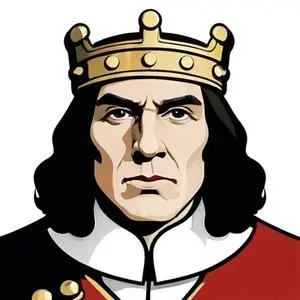
The last king of the House of York, infamous for allegedly murdering the Princes in the Tower to secure his throne, and his subsequent defeat at Bosworth Field.
Richard III of England, the last king of the Plantagenet dynasty, is infamous for his role in one of the most scandalous and intrigue-filled periods in English history. His reign, marked by power struggles, family feuds, and tragic events, continues to fascinate historians and scholars to this day.
Born on October 2, 1452, Richard was the youngest son of Richard, Duke of York, and Cecily Neville. Following the death of his father in 1460, Richard's older brother, Edward IV, became king, and Richard was created Duke of Gloucester in 1461. During the Wars of the Roses, Richard and Edward fought against the Lancastrian branch of the royal family, ultimately emerging victorious.
In 1472, Richard married Anne Neville, daughter of Richard Neville, 16th Earl of Warwick, and widow of Edward of Westminster, son of Henry VI. This strategic marriage cemented Richard's claim to the throne and secured crucial alliances.
When Edward IV died unexpectedly in April 1483, Richard was named Lord Protector of the realm for Edward's 12-year-old son, Edward V. However, before Edward V's coronation, Richard declared the marriage of Edward IV and Elizabeth Woodville invalid, making Edward V and his siblings illegitimate and ineligible for the throne. On June 25, 1483, an assembly of lords and commoners endorsed Richard's claim to the throne, and he was crowned king on July 6, 1483.
Richard's reign was marked by two significant rebellions. The first, led by Henry Stafford, 2nd Duke of Buckingham, failed in October 1483. The second, led by Henry Tudor (later Henry VII) and his uncle, Jasper Tudor, culminated in the Battle of Bosworth Field on August 22, 1485, where Richard was killed.
Richard's reputation has been forever tarnished by the disappearance and presumed murder of the Princes in the Tower, Edward V and Richard of Shrewsbury, Duke of York.
Richard III's defeat at Bosworth Field marked the end of the Plantagenet dynasty and the beginning of the Tudor dynasty. His reign, though brief, had significant consequences for English history, shaping the course of the monarchy and the nation.
"So wise so wise so wise, and yet, so foolish." - Richard III, in William Shakespeare's play of the same name.
Richard III's legacy is often contrasted with that of his predecessors, Edward IV and Henry VI, as well as his successor, Henry VII. While he was a skilled military leader and strategist, his ruthless ambition and questionable morality have overshadowed his achievements.
Born in 1284
The king whose disastrous reign led to his eventual deposition and mysterious death, remembered for his alleged homosexual relationships and power struggles with nobles.
Born in 1367
The last king of the House of Plantagenet, deposed in a coup, known for his extravagance and tyranny, leading to his downfall and the rise of the Lancastrian dynasty.
Born in 1133
King of England from 1154 to 1189, known for establishing a strong centralized government, reforming the English church, and his tumultuous relationships with Thomas Becket and his sons.
Born in 1430
Wife of King Henry VI of England, she played a significant role in the Wars of the Roses, leading the Lancastrian faction and fighting for her husband's claim to the throne.
Born in 1456
The wife of Richard III and daughter of Warwick the Kingmaker, she played a pivotal role in the Wars of the Roses, becoming Queen of England after her husband's ascension to the throne.
73 Years Old
A British singer-songwriter and pianist known for his emotive, poetic lyrics and soaring melodies, crafting introspective and atmospheric indie-pop soundscapes.
