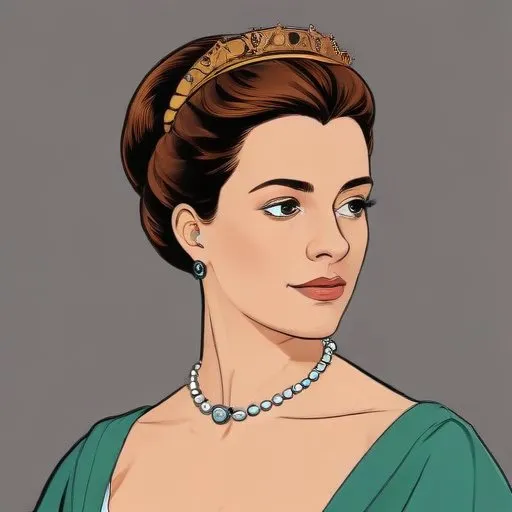
Joanna of Austria, Princess of Portugal: A Life of Royal Duty and Devotion
A Regent of Spain and Mother of a King
Joanna of Austria, Princess of Portugal, is remembered as a devoted regent of Spain and the mother of King
Sebastian of Portugal, who ruled the Portuguese Empire during its golden age. Born into the illustrious House of Habsburg, Joanna's life was marked by royal duty, personal sacrifice, and a deep commitment to her faith.
Early Life and Education
Born on June 24, 1535, in Madrid, Joanna was the daughter of
Charles V, Holy Roman Emperor, and his wife,
Isabella of Portugal. She was named after her paternal grandmother, Queen Joanna of Castile, and the Nativity of St. John the Baptist. At the tender age of four, Joanna was motherless and entrusted to Doña Leonor de Mascareñas. By eight, she could understand Latin and play several musical instruments.
Princess of Portugal
On January 11, 1552, at the age of sixteen, Joanna married her double first cousin, John Manuel of Portugal, by proxy in Toro. She arrived at the Portuguese court in November 1552, where she was greeted with lavish festivities. The marriage, however, was cut short when John Manuel died of tuberculosis in 1554, leaving Joanna a widow at eighteen.
Regent of Spain
Following her husband's demise, Joanna returned to Spain at her father's request, leaving her son, King Sebastian, in the care of her mother-in-law, Catherine of Austria, who was also her aunt. During her brother
Philip II's trips to England to marry Mary I, Joanna served as regent of Spain from 1554 to 1556 and again from 1556 to 1559. Her wise governance and diplomatic skills earned her respect and admiration during this period.
Life of Devotion
In later life, Joanna dedicated herself to religious affairs, becoming a patron of the Jesuits and supporting the construction of several convents and churches. She maintained a close relationship with her son, King Sebastian, through letters and portraits, although they never reunited.
Legacy
Joanna of Austria, Princess of Portugal, left an indelible mark on Spanish and Portuguese history. As a regent, mother, and patron of the arts, she embodied the virtues of her illustrious heritage. Her life serves as a testament to the strong women who shaped the fate of nations during the Renaissance era.
- Archduchess of Austria
- Infanta of Castile and of Aragon
- Princess of Burgundy
Timeline of Key Events
- June 24, 1535: Born in Madrid, Spain
- 1552: Married John Manuel of Portugal by proxy in Toro
- 1554: Became a widow at eighteen following John Manuel's death
- 1554-1556 and 1556-1559: Served as regent of Spain during Philip II's trips to England
- 1573: Died on September 7 in Madrid, Spain
Personal Anecdotes
Joanna's love for music and art was well-known among her contemporaries. She was an accomplished musician and patron of the arts, supporting several prominent artists of her time.
Inspirational Quotes
"My duty is to serve the crown, but my heart belongs to God."
"Faith is the anchor that holds me steady in the tempests of life."
FAQ
What was Joanna of Austrias role in the royal courts of Europe?
Joanna of Austria was a member of the royal courts of Europe, serving as the Princess of Portugal and later as the Regent of Portugal. She played a key role in maintaining Habsburg influence in Portugal and Spain.
How did Joanna of Austria shape Portuguese politics?
Joanna of Austria shaped Portuguese politics through her marriage to John Manuel, Prince of Portugal, and her subsequent regency. She promoted Habsburg interests and maintained Portugals independence from Spain.
What was Joanna of Austrias relationship with her siblings?
Joanna of Austria was close to her siblings, particularly her brother Philip II of Spain, with whom she maintained a strong alliance. She often acted as a mediator between her siblings and other European monarchs.
What were Joanna of Austrias cultural achievements?
Joanna of Austria was a patron of the arts and culture, promoting the development of literature, music, and architecture in Portugal. She also supported the establishment of convents and other religious institutions.
How is Joanna of Austria remembered in history?
Joanna of Austria is remembered as a skilled politician, a devoted patron of the arts, and a dedicated member of the Habsburg family. Her legacy reflects the complex and often tumultuous nature of European royal politics in the 16th century.