


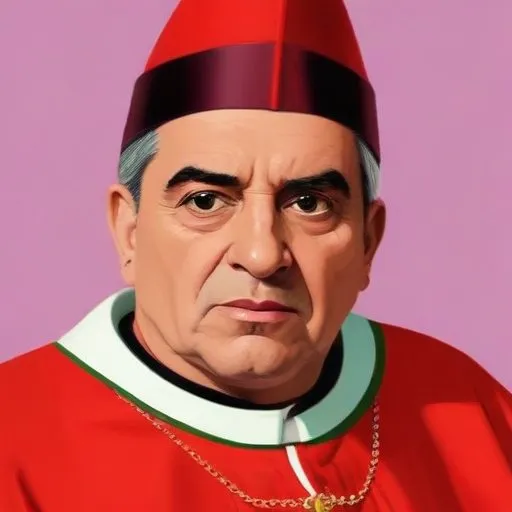
A powerful Spanish-Italian cardinal who played a crucial role in shaping the Catholic Church's politics and policies during the 17th century, particularly in his native Spain. He was a skilled diplomat and strategist who navigated the complex web of royal and papal alliances with ease.
Joaqun Fernndez de Portocarrero, a renowned Spanish diplomat and statesman, is best known for his remarkable career as the Spanish Ambassador to Rome and his significant role in shaping the country's foreign policy during the 18th century. Throughout his illustrious career, he demonstrated exceptional diplomatic skills, earning the trust and respect of European monarchs and dignitaries.
Born in 1681 in Madrid, Spain, Joaqun Fernndez de Portocarrero came from a noble family with a long history of public service. He received an excellent education, which laid the foundation for his future success in the world of diplomacy. His father, a high-ranking official in the Spanish government, instilled in him the importance of public service and the art of statesmanship.
Fernndez de Portocarrero's diplomatic career began in 1704, when he was appointed as the Spanish Ambassador to Venice. He quickly gained recognition for his exceptional diplomatic skills, earning the trust of the Venetian government and establishing strong relationships with the European aristocracy. His success in Venice led to his appointment as the Spanish Ambassador to Rome in 1713, a position he held for over three decades.
Fernndez de Portocarrero's tenure as the Spanish Ambassador to Rome was marked by several significant achievements. He played a key role in negotiating the Treaty of The Hague (1720), which established a temporary peace between Spain and the Quadruple Alliance (Great Britain, France, Austria, and the Dutch Republic). He also facilitated the recognition of Philip V of Spain as the rightful king of Spain by the Holy See, a crucial milestone in Spain's struggle for legitimacy.
Fernndez de Portocarrero's remarkable diplomatic career had a lasting impact on Spanish foreign policy and the country's relationships with European monarchies. He set a high standard for Spanish diplomats, demonstrating the importance of effective negotiation, strategic alliances, and strong relationships with European powers.
Historians regard Fernndez de Portocarrero as one of the most influential Spanish diplomats of the 18th century, and his legacy continues to inspire future generations of diplomats and statesmen.
Beyond his diplomatic achievements, Fernndez de Portocarrero was a devoted philanthropist and patron of the arts. He supported several charitable institutions in Rome and Madrid, and his love for literature and art led him to sponsor various cultural projects.
Fernndez de Portocarrero's personal life was marked by tragedy, including the loss of his wife and children. Despite these challenges, he remained committed to his duties as a diplomat and statesman, earning the respect and admiration of his contemporaries.
Fernndez de Portocarrero passed away on June 22, 1760, in Madrid, leaving behind a legacy of exceptional diplomacy and statesmanship. His remarkable career serves as a testament to the power of effective diplomacy, and his contributions to Spanish foreign policy continue to influence the country's relations with European powers.
In conclusion, Joaqun Fernndez de Portocarrero's remarkable life and career serve as a shining example of exceptional diplomacy, strategic thinking, and dedicated public service. His legacy continues to inspire future generations of diplomats, statesmen, and leaders, cementing his place in the annals of Spanish history.
Born in 1431
Ruthless and cunning, this Pope was infamous for his corrupt and immoral ways, using his power to further his family's interests.
Born in 1487
A 16th-century Pope who commissioned Michelangelo to paint the Sistine Chapel's frescoes and was a patron of the arts, leaving a lasting impact on Renaissance art and architecture.
Born in 1535
The second shortest-reigning pope in history, serving for just 27 days in 1605, he is most known for his brief but tumultuous papacy marked by power struggles and controversy.
Born in 1459
A Dutch priest who served as the Pope of the Catholic Church from 1522 to 1523, known for his attempts to reform the Church and his strong stance against corruption.
Born in 1536
Led the Catholic Church during a tumultuous period, issuing papal bulls and playing a key role in the Counter-Reformation. He's also famous for his coffee habit, being the first Pope to try and approve of it.
Born in 1417
A 15th-century pope who played a significant role in the fall of the Western Schism, ending the division in the Catholic Church. He's also known for his lavish spending and nepotism.
Born in 1487
A 16th-century Pope who commissioned Michelangelo to paint the Sistine Chapel's frescoes and was a patron of the arts, leaving a lasting impact on Renaissance art and architecture.
Born in 1504
Leader of the Catholic Church during the Counter-Reformation, he excommunicated Queen Elizabeth I and played a key role in the Council of Trent.
