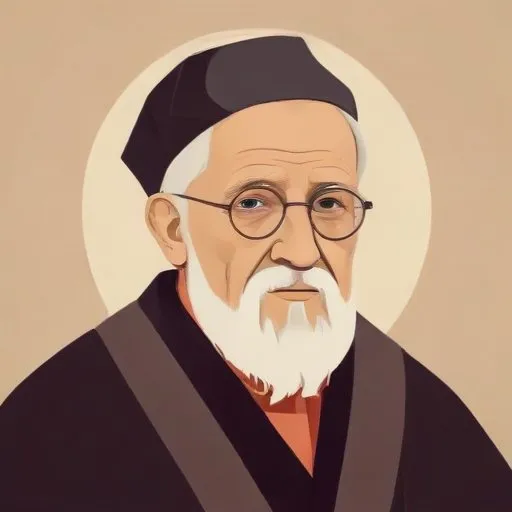
Johann Eck: The Fearless Catholic Theologian and Counter-Reformation Pioneer
Johann Eck, a German Catholic theologian, scholastic, and prelate, is best known for his unwavering stance against the Protestant Reformation, particularly his debates with
Martin Luther, one of the most influential figures of the Protestant movement. As a pioneer of the Counter-Reformation, Eck dedicated his life to defending Catholic dogma and refuting Protestant ideologies, earning him both admiration and criticism from his contemporaries.
A Humble Beginning
Born on November 13, 1486, in Eck, near Memmingen, Swabia, Johann Eck was the son of a peasant and bailiff, Michael Maier. His uncle, Martin Maier, a parish priest, undertook his education, which led him to the University of Heidelberg at the tender age of 12. Eck's academic prowess took him to Tübingen, where he earned his master's degree in 1501.
Rise to Prominence
Eck's academic journey continued at Freiburg University, where he studied theology and law under renowned scholars. His exceptional oratory skills and subtle reasoning abilities made him a brilliant teacher, and he soon gained a reputation as a mentor to prominent figures, including the Anabaptist leader Balthasar Hubmaier. In 1508, Eck entered the priesthood in Strasbourg, and two years later, he obtained his doctorate in theology.
A Life of Controversy and Debate
Eck's unwavering commitment to Catholicism led him to engage in heated debates with Protestant reformers, including Martin Luther. Their disagreements sparked a series of public disputes, which Eck documented in his writings. His most notable work,
Ludicra logices exercitamenta, was published in 1506 and showcased his exceptional reasoning skills. Eck's unrelenting criticisms of Protestantism earned him the title of "the hammer of heretics" among his Catholic peers.
Career Highlights and Major Works
- Ludicra logices exercitamenta (1506) - Eck's first published work, which demonstrated his exceptional reasoning skills.
- De primate Petri (1519) - A treatise on papal authority, which cemented his reputation as a defender of Catholicism.
- Enchiridion of Commonplaces (1525) - A comprehensive guide to Catholic theology, which became a seminal work of the Counter-Reformation.
Influence on Modern Society
Eck's contributions to the Counter-Reformation played a significant role in shaping Catholic doctrine and practice. His debates with Luther and other Protestant reformers helped to galvanize Catholic opposition to the Reformation. Today, Eck is remembered as a fearless Catholic theologian who dedicated his life to defending the faith.
Personal Milestones and Key Life Events
- 1486 - Born in Eck, near Memmingen, Swabia
- 1501 - Earned his master's degree from the University of Tübingen
- 1508 - Entered the priesthood in Strasbourg
- 1510 - Became a canon at Eichstätt and a professor at the University of Ingolstadt
- 1543 - Died on February 13, at the age of 56
Legacy and Impact
Johann Eck's unyielding commitment to Catholicism and his contributions to the Counter-Reformation have left an indelible mark on Catholic theology. While his methods may have been controversial, his dedication to defending the faith has inspired generations of Catholic scholars and theologians. Today, Eck is remembered as a champion of Catholic orthodoxy and a pioneer of the Counter-Reformation.
FAQ
What was Johann Ecks role in the Protestant Reformation?
Johann Eck was a prominent Catholic theologian who opposed the Protestant Reformation, engaging in public debates with Martin Luther and other Reformers.
What was the significance of Johann Ecks disputations with Martin Luther?
Johann Ecks disputations with Martin Luther in Leipzig in 1519 were a pivotal moment in the Protestant Reformation, marking a turning point in the debate over Catholic doctrine.
What were Johann Ecks contributions to Catholic theology?
Johann Eck wrote extensively on Catholic theology, producing works on topics such as justification, faith, and authority, and played a key role in shaping Catholic doctrine during the Counter-Reformation.
How did Johann Eck respond to the emerging Protestant movement?
Johann Eck was a vocal opponent of Protestantism, using his writings and public debates to counter the claims of Reformers and defend Catholic orthodoxy.
What was Johann Ecks relationship like with other Catholic leaders?
Johann Eck worked closely with other Catholic leaders, including Pope Leo X, to promote Catholic interests and counter the spread of Protestantism.