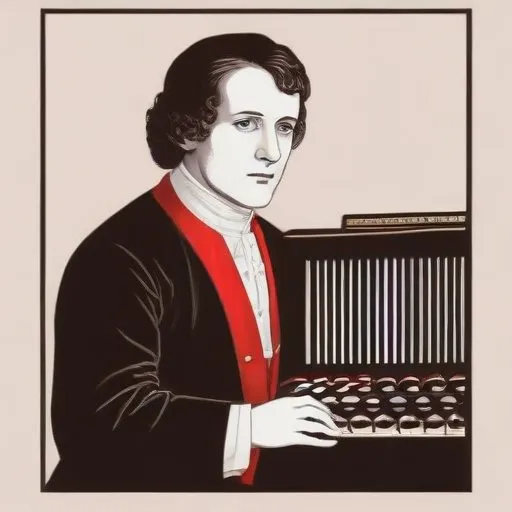
Johann Friedrich Agricola: The Maestro of Music and Theory
A Life Dedicated to Harmony and Critique
Johann Friedrich Agricola was a German composer, organist, singer, pedagogue, and writer on music, renowned for his versatility and expertise in multiple aspects of the musical world. His prolific output of Italian operas, Lieder, chorale preludes, and church music, particularly oratorios and cantatas, solidified his position as a master of his craft.
Early Life and Education
Born on January 4, 1720, in Dobitschen, Thuringia, Agricola's early life was marked by a strong affinity for music. While studying law at Leipzig University (1738-1741), he seized the opportunity to study music under the tutelage of the illustrious
Johann Sebastian Bach. This formative experience laid the groundwork for his future successes.
Rise to Prominence
In 1741, Agricola moved to Berlin, where he honed his skills in musical composition under
Johann Joachim Quantz. His exceptional talent as an organist soon earned him recognition as one of the most skilled in his time. The success of his comic opera,
Theory and Critique
Agricola's contributions to the world of music theory and critique are equally remarkable. In 1754, he co-authored, with Carl Philipp Emanuel Bach, the obituary of J.S. Bach. His 1757 work, Anleitung zur Singekunst (Introduction to the Art of Singing), is a translation of Pier Francesco Tosi's 1723 treatise Opinioni de' cantori antichi e moderniLegacy and Impact
Agricola's annotations on Jakob Adlung's Musica mechanica organoedi (1768) provide valuable insights into J.S. Bach's views on music. His theoretical and critical writings have had a lasting impact on the development of music theory, shaping the understanding and appreciation of music for generations to come.
Personal Life and Controversy
Agricola's personal life was not without controversy. He married Benedetta Emilia Molteni, a noted court operatic soprano, despite the king's prohibition on court employees marrying each other. As a result, the king reduced their combined salaries to a single annual salary of 1,000 Thalers. Agricola's dedication to his craft and his defiance of authority are testaments to his unwavering passion for music.
A Lasting Legacy
Johann Friedrich Agricola's multifaceted career has left an indelible mark on the world of music. His operas, compositions, and theoretical writings continue to inspire and educate musicians to this day. As a testament to his enduring impact, Agricola's legacy serves as a reminder of the transformative power of music to bring people together and transcend the boundaries of time and authority.
FAQ
What was Johann Friedrich Agricolas most famous composition?
Johann Friedrich Agricolas most famous composition is the oratorio Il tempio dEtere, a large-scale work that showcased his skill as a composer.
What was Johann Friedrich Agricolas role in the development of the Berlin Opera?
Johann Friedrich Agricola played a key role in the development of the Berlin Opera, serving as its director and promoting the work of other composers.
How did Johann Friedrich Agricolas music reflect his personality?
Johann Friedrich Agricolas music is known for its elegance, refinement, and technical skill, reflecting his personality as a cultivated and sophisticated musician.
What was Johann Friedrich Agricolas relationship with the Prussian royal court?
Johann Friedrich Agricola had a close relationship with the Prussian royal court, where he worked as a composer and musician.
What legacy did Johann Friedrich Agricola leave behind?
Johann Friedrich Agricola left behind a legacy as a skilled composer and musician who made significant contributions to the development of opera and classical music in Berlin.