


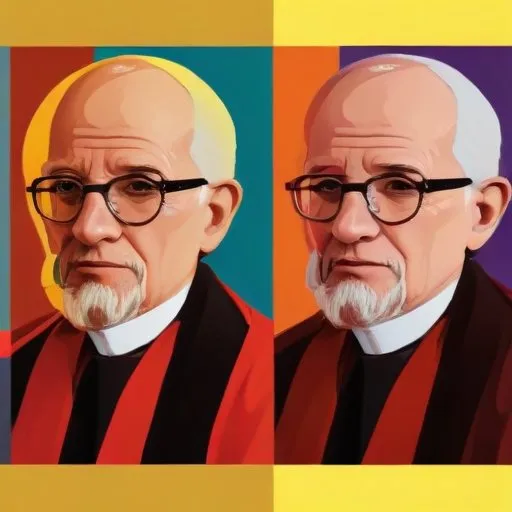
A prominent Lutheran theologian and academic of the early 17th century, known for his comprehensive systematic theology and influential writings that shaped Lutheran orthodoxy.
Johann Gerhard was a prominent Lutheran theologian and church leader during the period of Orthodoxy, known for his significant contributions to Lutheran Scholastic theology and his influential writings on dogmatic, polemical, and practical theology. He played a crucial role in shaping the Lutheran Church's doctrine and practice, earning him the reputation as one of the greatest living theologians of Protestant Germany in his time.
Born on October 17, 1582, in Quedlinburg, Germany, Gerhard's life took a dramatic turn when he fell ill at the age of fourteen. Under the guidance of Johann Arndt, author of Das wahre Christenthum, Gerhard resolved to study for the church. He pursued his education at the University of Wittenberg, where he studied philosophy and theology, and later at Jena, where he received a new impulse from prominent theologians J.W. Winckelmann and Balthasar Mentzer.
Gerhard's academic career spanned multiple universities, including Jena, where he became a lecturer in 1605, and later, the senior theological professor. During this period, he formed the Trias Johannea with Johann Major and Johann Himmel, solidifying his position as a leading theologian. His writings, which number over 100, include commentaries on the Bible, dogmatic and polemical works, and devotional literature.
Gerhard's impact on modern society is evident in his role in shaping the Lutheran Church's doctrine and practice. His writings and teachings continue to influence Lutheran theology to this day. He played a significant role in the disputations of his time, offering advice on public and domestic questions touching on religion or morals.
Gerhard's philosophical contributions were deeply rooted in his Lutheran theology. He believed in the authority of Scripture and the importance of dogmatic theology. His writings demonstrate a commitment to the principles of Lutheran orthodoxy, and he was a vocal opponent of Calvinism and other heterodox movements.
In addition to his academic and theological pursuits, Gerhard's life was marked by significant personal milestones. He received repeated calls to prestigious universities in Germany and Sweden, a testament to his reputation as a leading theologian. He died on August 17, 1637, in Jena, leaving behind a legacy that continues to shape Lutheran theology.
Johann Gerhard's contributions to Lutheran theology and his influential writings have cemented his place in history as one of the most significant Lutheran theologians of his time. His legacy continues to inspire and inform Lutheran theology to this day.
Born in 1483
A German monk and priest who sparked the Protestant Reformation, challenging Catholic Church authority and shaping Western Christianity. He's famous for nailing 95 theses to a church door, sparking a religious revolution.
Born in 1497
A 16th-century Renaissance scholar who made significant contributions to the development of the Protestant Reformation and education, known for his theological writings and astronomical observations.
Born in 1509
A French pastor and theologian who played a key role in the Protestant Reformation, shaping Christian theology and influencing Western civilization. He's famous for his teachings on predestination and his role in establishing Calvinism.
Born in 1484
Leader of the Swiss Reformation, advocating for church reform and inspiring other Protestant movements.
Born in 1522
A 16th-century astrologer and theologian who merged Christian theology with astrological concepts, influencing Lutheran thought and reform. He's known for his critiques of Catholicism and papal authority.
Born in 1520
A 16th-century Croatian theologian and reformer who played a key role in shaping the Lutheran Reformation, particularly through his writings on the nature of sin and justification. He's also known for his critical approach to biblical interpretation.
Born in 1485
A key figure in the Protestant Reformation, he played a crucial role in shaping Lutheran theology and was a close advisor to Martin Luther. He's also known for his work in establishing the Lutheran Church in Denmark and Norway.
Born in 1498
A 16th-century theologian who sparked controversy by anonymously publishing a preface to Copernicus' De revolutionibus orbium coelestium, which led to a misunderstanding of the astronomer's heliocentric model. They also contributed to the development of Lutheran theology.
