


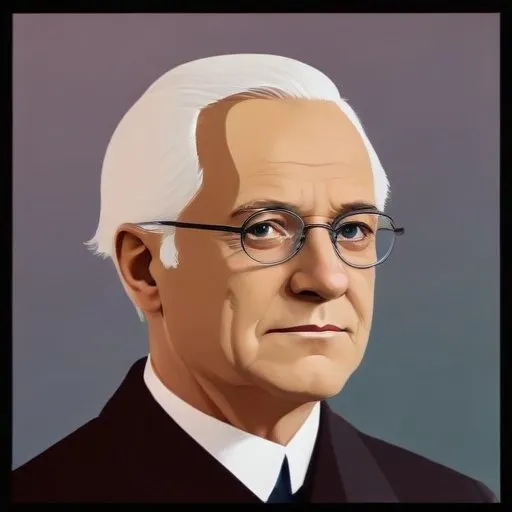
A prominent 18th-century German jurist who made significant contributions to the development of international law, particularly in the areas of diplomacy and state sovereignty.
Johann Jakob Moser, a renowned German jurist, publicist, and researcher, is celebrated as the Father of German Constitutional Law. His tireless commitment to the principles of Liberalism led him to lose academic positions and suffer years of political imprisonment, yet his legacy endures as a beacon of dedication to the rule of law.
Moser was born on January 18, 1701, in Stuttgart, Germany, to a family of devoted Protestants with a long history of service to the Duchy of Wrttemberg. His parents, Johann Jacob Moser and Helene Catharine (née Misler), managed to fund his academic pursuits, allowing him to attend Eberhard-Ludwigs-Gymnasium and later study state journalism at the University of Tübingen.
Displaying exceptional brilliance, Moser became a professor of law at the University of Tübingen at the tender age of 19. Despite his rapid rise, he found his income insufficient and began exploring other opportunities. His research and writing eventually earned him recognition, leading to his appointment as an adviser to the state vice-chancellor Count Schnborn in Vienna in 1724.
In 1721, Moser married Friederike Rosine Vischer, daughter of a Württembergian Upper Council President. Their son, Friedrich Karl von Moser, followed in his father's footsteps, becoming a jurist, political writer, and statesman. Moser's family life was marked by a strong sense of duty and public service, reflecting his unwavering commitment to the principles of Liberalism.
Moser's work laid the foundation for the development of German constitutional law, shaping the country's legal framework and influencing generations of jurists and politicians. His dedication to Liberalism continues to inspire civil libertarians and advocates for human rights worldwide.
Moser's philosophical outlook was characterized by a strong belief in the principles of individual liberty, democracy, and the rule of law. He advocated for the separation of powers, limits on state authority, and the protection of civil rights, establishing himself as a pioneer in the field of constitutional law.
Living during a time of significant social and political upheaval, Moser's work provided a beacon of hope for those seeking reform and greater freedom. His legacy serves as a testament to the power of dedication and sacrifice in the pursuit of a just and equitable society.
Johann Jakob Moser's remarkable life and legacy continue to inspire and educate scholars, jurists, and civil libertarians around the world, cementing his place as one of the most important figures in the development of German constitutional law.
Born in 1724
Developed influential philosophical frameworks, such as the Critique of Pure Reason, that shaped modern Western thought on ethics, morality, and human understanding.
Born in 1749
A German literary giant who penned iconic works like "Faust" and "The Sorrows of Young Werther", shaping the Romantic movement and influencing countless writers.
Born in 1759
A renowned poet and playwright who crafted influential works that explored the human condition, morality, and the struggle for freedom, leaving a lasting impact on German literature.
Born in 1770
A German philosopher and academic who developed a comprehensive and systematic philosophy that emphasized the unity of all things and the dialectical process of thesis, antithesis, and synthesis. His ideas have had a profound impact on modern thought, influencing fields such as philosophy, politics, and art.
Born in 1777
A pioneer in mathematics and physics, he made major contributions to number theory, algebra, and electromagnetism, shaping our understanding of the natural world.
Born in 1768
A pioneering theologian and philosopher who shaped modern Christian thought and hermeneutics, known for his emphasis on individual experience and understanding of religious texts.
Born in 1769
A German writer and poet who advocated for German unification and nationalism through his patriotic works, inspiring a sense of national identity and pride.
