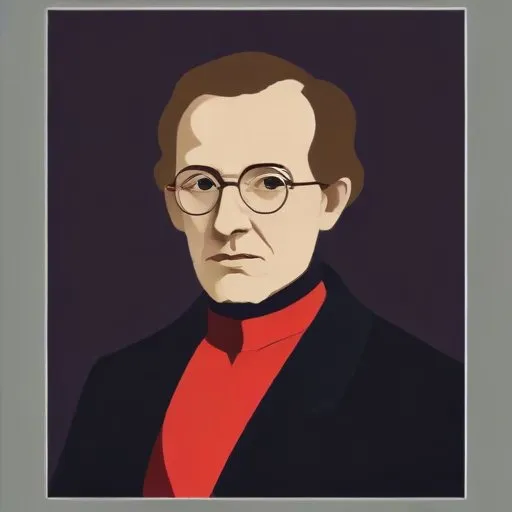
Johann Karl Friedrich Rosenkranz: The Philosopher Who Bridged the Gap Between Hegel and Kant
Johann Karl Friedrich Rosenkranz was a German philosopher who made significant contributions to the development of German idealism, particularly in bridging the gap between the philosophies of
Georg Wilhelm Friedrich Hegel and
Immanuel Kant. He is best known for his comprehensive and systematic expositions of Hegel's philosophy, which helped to further popularize Hegel's ideas and establish him as a leading figure in the field.
Early Life and Education
Rosenkranz was born on April 23, 1805, in Magdeburg, Prussia (now part of Germany). He came from a family of modest means and was forced to work as a tutor to support himself while pursuing his education. Despite these challenges, Rosenkranz was an exceptional student and went on to study philosophy at the University of Berlin, where he earned his Ph.D. in 1831.
Philosophical Contributions and Beliefs
Rosenkranz's philosophical contributions were largely centered around his work on Hegel's philosophy. He saw Hegel's ideas as a way to overcome the limitations of Kant's critical philosophy and develop a more comprehensive and systematic understanding of reality. Rosenkranz's own philosophical views were shaped by his extensive research on Hegel's works, and he became known for his expertise in Hegelian philosophy.
Rosenkranz's most significant contribution was his development of a philosophical system that integrated elements of both Hegel's and Kant's philosophies. He argued that Hegel's dialectical method was a more effective way of understanding reality than Kant's transcendental idealism, but he also recognized the importance of Kant's critiques of metaphysics and ethics.
Major Works
Rosenkranz's most notable works include:
- Hegel als deutscher Nationalphilosoph (Hegel as German National Philosopher), which provided a comprehensive and systematic exposition of Hegel's philosophy;
- Kritik der Hegelschen Philosophie (Critique of Hegel's Philosophy), which offered a critical analysis of Hegel's ideas;
- Die Naturphilosophie Hegels (Hegel's Philosophy of Nature), which explored Hegel's views on natural philosophy;
- Die Pädagogik als System (Pedagogy as a System), which outlined Rosenkranz's own views on education and pedagogy.
Influence on Modern Society
Rosenkranz's work had a significant impact on the development of German idealism and the spread of Hegel's ideas. His comprehensive expositions of Hegel's philosophy helped to make Hegel's ideas more accessible to a wider audience, and his integration of Kant's and Hegel's philosophies paved the way for subsequent philosophers to build upon.
Rosenkranz's emphasis on the importance of education and pedagogy also had a lasting impact on modern society. His views on education as a systemic process that aims to develop the whole person – intellectually, morally, and aesthetically – continue to influence educational theory and practice to this day.
Personal Milestones and Key Life Events
Rosenkranz's personal life was marked by several significant events that shaped his career and philosophical views. One of the most notable events was his meeting with Hegel in 1829, which had a profound impact on his philosophical development.
Rosenkranz was also known for his strong social conscience and his commitment to social justice. He was an active member of the German liberal movement and played a key role in the Revolution of 1848, which sought to establish a more democratic and equitable society in Germany.
Legacy
Rosenkranz's legacy is twofold. On the one hand, he played a crucial role in popularizing Hegel's ideas and establishing him as a leading figure in German idealism. On the other hand, his own philosophical contributions helped to shape the development of German philosophy in the 19th century.
Today, Rosenkranz is recognized as a key figure in the history of German philosophy, and his work continues to influence scholars and philosophers around the world. His commitment to social justice and education remains an inspiration to many, and his philosophical ideas continue to provide insights into the nature of reality, knowledge, and human experience.
FAQ
What were Johann Karl Friedrich Rosenkranzs contributions to philosophy?
Rosenkranz was a German philosopher who made significant contributions to the fields of aesthetics, ethics, and metaphysics, and was a prominent figure in the development of German idealism.
What was Johann Karl Friedrich Rosenkranzs relationship with Georg Wilhelm Friedrich Hegel?
Rosenkranz was a student and follower of Hegel, and later edited and published many of Hegels works.
What were Johann Karl Friedrich Rosenkranzs notable publications?
Rosenkranz wrote several influential books, including Aesthetik des Hässlichen and System der Wissenschaft.
How did Johann Karl Friedrich Rosenkranzs work influence the development of German idealism?
Rosenkranzs ideas on aesthetics, ethics, and metaphysics contributed to the evolution of German idealism, influencing thinkers such as Friedrich Schelling and Arthur Schopenhauer.
What is Johann Karl Friedrich Rosenkranzs legacy in the history of philosophy?
Rosenkranzs work bridged the gap between Hegel and later German philosophers, ensuring the continued development of German idealism in the 19th century.