


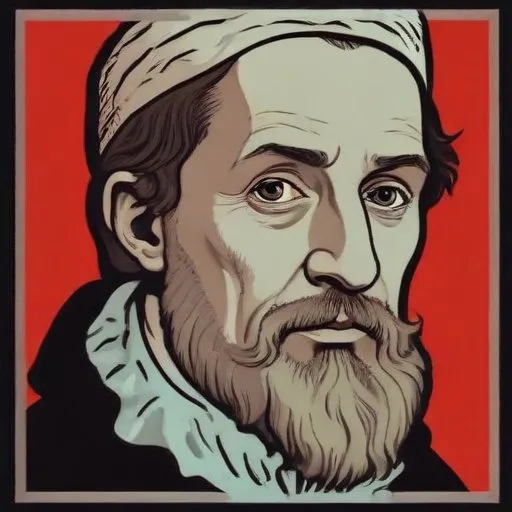
A Swiss poet and physiognomist who wrote extensively on the art of face-reading, believing that facial features could reveal a person's character and destiny. His work was widely popular in the 18th century.
Johann Kaspar Lavater, a Swiss poet, writer, philosopher, physiognomist, and theologian, is best known for his groundbreaking work in the field of physiognomy, which laid the foundation for the modern study of facial features and character analysis. His seminal work, Physiognomische Fragmente zur Befrderung der Menschenkenntnis und Menschenliebe, published between 1775 and 1778, introduced the concept that individual character traits could be determined by examining the lines and features of a person's face.
Lavater was born on November 15, 1741, in Zurich, Switzerland. He received his education at the Gymnasium in Zurich, where he was mentored by prominent scholars such as J.J. Bodmer and J.J. Breitinger. This education laid the groundwork for his future pursuits in literature, philosophy, and theology.
At the tender age of 21, Lavater demonstrated his courage and conviction by denouncing a corrupt magistrate, who was forced to return ill-gotten gains. This bold act, undertaken in conjunction with his friend Henry Fuseli, a painter, established Lavater as a champion of justice and integrity.
In 1769, Lavater took holy orders in the Zwinglian Church in Zurich, where he served as a deacon and pastor until his death. His oratory skills and genuine conviction earned him great respect and influence, making him a sought-after counselor and confidant.
Lavater's work in physiognomy revolutionized the field by introducing the idea that individual character traits could be determined by examining facial features. His book, Physiognomische Fragmente, consisted of a collection of silhouettes, accompanied by descriptive texts, which aimed to elucidate the connection between facial features and personality.
Lavater's work in physiognomy sparked a golden age for silhouettes, as people became fascinated by the idea of uncovering hidden truths about themselves and others through facial analysis. The art of silhouette-making became a popular pastime, with Lavater's book serving as a guide for enthusiasts and amateurs alike.
Lavater's work had far-reaching implications, influencing fields beyond physiognomy. His ideas on facial analysis were applied in various areas, including art, literature, and psychology. His work also inspired a new generation of thinkers and writers, including Johann Wolfgang von Goethe and Friedrich Schiller.
Lavater's work was not without controversy. Critics argued that his theories were overly simplistic and failed to account for the complexities of human nature. Additionally, his attempt to convert Moses Mendelssohn to Christianity sparked a heated debate, with many prominent intellectuals speaking out against Lavater's actions.
Johann Kaspar Lavater's contributions to the field of physiognomy have left a lasting impact, shaping our understanding of facial features and character analysis. His work continues to inspire and influence scholars, artists, and thinkers to this day.
Born in 1749
A German literary giant who penned iconic works like "Faust" and "The Sorrows of Young Werther", shaping the Romantic movement and influencing countless writers.
Born in 1759
A renowned poet and playwright who crafted influential works that explored the human condition, morality, and the struggle for freedom, leaving a lasting impact on German literature.
Born in 1724
Developed influential philosophical frameworks, such as the Critique of Pure Reason, that shaped modern Western thought on ethics, morality, and human understanding.
Born in 1712
A pioneering thinker who shaped modern democracy and education with his ideas on social contracts, general will, and the importance of early childhood education. His writings influenced the French Revolution and modern political thought.
Born in 1694
A witty and insightful 18th-century writer and philosopher who used satire to critique societal norms and advocate for reason, tolerance, and human rights.
Born in 1729
A prominent Enlightenment thinker, he's known for his influential writings on philosophy, literature, and theology, which helped shape modern German culture. He's also credited with developing the concept of dramatic irony in literature.
