


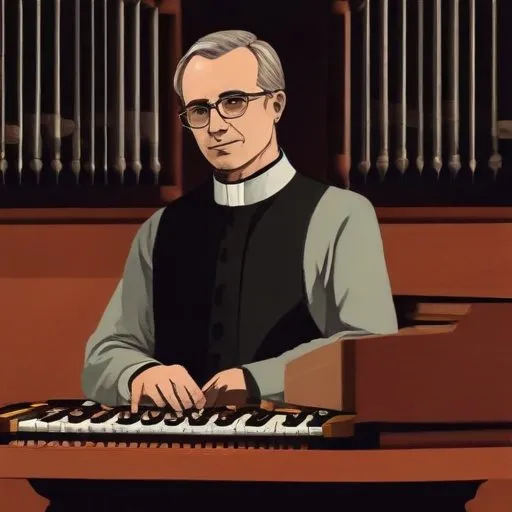
A renowned Baroque-era organist and composer, known for his intricate and expressive works that showcased his mastery of counterpoint and fugue. His compositions continue to inspire and influence organ music to this day.
Johann Krieger, born on December 28, 1651, was a renowned German composer and organist of the Baroque period, celebrated for his exceptional keyboard music and esteemed by prominent figures like George Frideric Handel. He is best known for his prolific compositions of church and secular music, with numerous published works and manuscripts that showcase his remarkable contrapuntal skill.
Krieger was born in Nuremberg, Germany, into a family of rug makers. He received his early education in music at St. Sebaldus, where he studied with Heinrich Schwemmer, a prominent teacher who had taught Johann Pachelbel. Krieger later honed his keyboard skills with Georg Caspar Wecker. His older brother, Johann Philipp Krieger, also a composer, studied with a pupil of Froberger, Johann Drechsel.
Krieger's professional career began in 1671, when he studied composition at Zeitz. He later worked at Bayreuth, Zeitz, and Greiz before settling in Zittau, where he spent most of his life. During this period, he composed a vast amount of music, including harpsichord suites, organ toccatas, fugues, and ricercars. His published collections, Sechs musicalische Partien (1697) and Anmuthige Clavierbung (1698), demonstrate his mastery of the keyboard.
Krieger's contemporaries, including Johann Mattheson, praised his exceptional contrapuntal skill, particularly in his double fugues. Mattheson stated that he knew nobody who surpassed Krieger in this form, except Handel. Handel himself admired and studied Krieger's work, even taking a copy of Anmuthige Clavierbung with him to England.
Although hundreds of Krieger's works were lost in a fire that destroyed Zittau in 1757, during the Seven Years' War, his surviving compositions remain a testament to his significance as a German composer of his time. His keyboard music places him among the most important figures of the Baroque period, and his influence can be seen in the works of later composers.
Krieger's contributions to the world of music have had a lasting impact on modern society. His compositions continue to inspire and influence musicians, musicologists, and enthusiasts alike, ensuring his legacy as a pioneering figure in the world of classical music.
While Krieger's life was marked by his dedication to music, he also experienced personal milestones, including his move to Zittau, where he spent most of his life. His relationships with prominent composers, such as Handel, further highlight his significance in the musical circles of his time.
Today, Johann Krieger is remembered as a towering figure in the world of Baroque music, celebrated for his exceptional compositions and his lasting impact on the development of classical music.
These published collections showcase Krieger's mastery of the keyboard, featuring harpsichord suites, organ toccatas, fugues, and ricercars.
Born in 1685
A master of Baroque music, he composed over 1,000 works, including orchestral suites, cantatas, and passions, that still inspire and influence musicians today. His innovative use of counterpoint and harmony raised the bar for classical music.
Born in 1685
A renowned Baroque composer and organist, famous for creating majestic orchestral suites, operas, and oratorios, including the iconic "Messiah" masterpiece.
Born in 1585
A renowned Baroque composer and organist, known for his contributions to the development of the oratorio and passion genres, creating over 500 works that showcased his mastery of choral music.
Born in 1587
A renowned Baroque-era musician and teacher, known for his influential compositions and contributions to the development of the organ concerto.
Born in 1653
A renowned Baroque composer and organist, famous for his iconic Canon in D major, a staple at weddings and a testament to his enduring musical legacy.
Born in 1809
A renowned 19th-century musician who masterfully blended classical and romantic styles, creating iconic works like the "Wedding March" and "Elijah" oratorio. His compositions continue to inspire and influence generations of artists.
Born in 1810
A renowned Romantic-era composer and influential music critic, known for his expressive and emotionally charged works, including symphonies, piano music, and art songs.
