


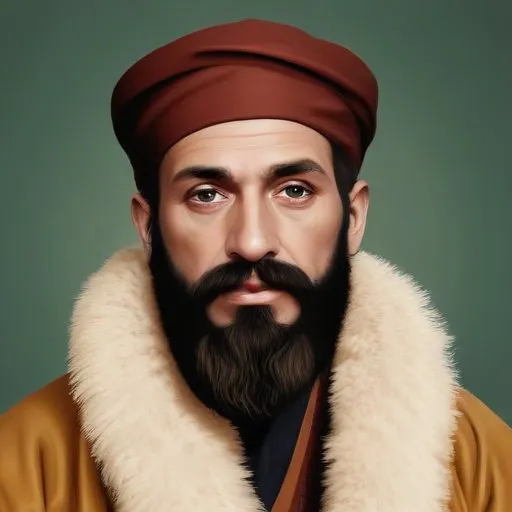
Dutch expert in zoology, oriental studies, and ethnography, known for contributions to the fields of Indonesian languages and cultures, as well as the discovery of new animal species.
Johannes Franois Snelleman was a Dutch zoologist, orientalist, and ethnographer who made significant contributions to the field of natural history, particularly in the Netherlands East Indies. He is best known for his expeditions to Central Sumatra and Angola, as well as his role as editor of the Encyclopaedie van Nederlandsch-Indië, a comprehensive encyclopedia on the Netherlands East Indies.
Snelleman was born on December 26, 1852, in Rotterdam, Netherlands, to Christiaan Snelleman and Sara Lacombe. Little is known about his early life and education, but it is clear that he developed a strong passion for natural history and exploration from an early age.
Between 1887 and 1889, Snelleman participated in a scientific expedition to Central Sumatra, led by Lieutenant Johannes Schouw Santvoort, to map the Hari River basin and research the natural environment and indigenous people. This expedition was organized by the Royal Netherlands Geographical Society, and Snelleman's contributions as a zoologist were invaluable. He wrote a book about the expedition, detailing his findings and observations.
In the following years, Snelleman participated in another expedition to Angola, where he worked closely with D.D. Veth, a fellow scientist and son of P.J. Veth, the chairman of the Royal Netherlands Geographical Society. Tragically, D.D. Veth died of exhaustion during the expedition, but Snelleman and P.J. Veth collaborated on a book about the expedition and D.D. Veth's life.
Snelleman's editorial work was instrumental in shaping the understanding of the Netherlands East Indies. He was editor of the four-volume Encyclopaedie van Nederlandsch-Indië, which was started in 1896 by P.A. van der Lith. Snelleman worked on volumes two and three, and after Van der Lith's death in 1901, he completed the final volume as sole editor. This encyclopedia remains a seminal work on the region's geography, ethnography, and history.
Snelleman also collaborated with H.D. Benjamins on the Encyclopaedie van Nederlandsch-West-Indië, a comprehensive encyclopedia on the Dutch West Indies. Additionally, he co-founded the journal De West-Indische Gids with Benjamins, which provided a platform for scholars to share their research and findings on the region.
Snelleman was married three times, to Josepha Hendrika Dupont, Catharina Johanna Elisabeth Augusta Inckel, and Theodora Maria Beun. He passed away on May 18, 1938, in The Hague, leaving behind a legacy of scientific contributions and editorial excellence.
Johannes Franois Snelleman's contributions to the fields of zoology, orientalism, and ethnography have had a lasting impact on our understanding of the natural world and human societies. His editorial work and publications have inspired generations of scholars and researchers, and his legacy continues to influence the study of natural history and ethnography today.
Born in 1809
Developed the theory of evolution through natural selection, revolutionizing our understanding of life on Earth. This groundbreaking idea transformed the fields of biology, ecology, and beyond.
Born in 1823
A pioneering naturalist who discovered evolution through natural selection, independently of Charles Darwin, and contributed significantly to the field of biogeography.
Born in 1834
A German biologist, physician, and philosopher who coined the term "ecology" and made significant contributions to the field of evolutionary biology, including the recapitulation theory.
Born in 1810
Discovered the Schwann cells, a type of cell that provides support to neurons in the peripheral nervous system, and formulated the theory of cellular structure, which states that all living organisms are composed of cells.
Born in 1804
A German botanist who, along with Theodor Schwann, formulated the cell theory, which states that all living organisms are composed of cells and that cells are the basic units of life.
Born in 1769
A pioneering geographer and explorer who mapped much of South America and discovered the Caspian Sea's connection to the Black Sea, greatly advancing our understanding of the natural world.
