


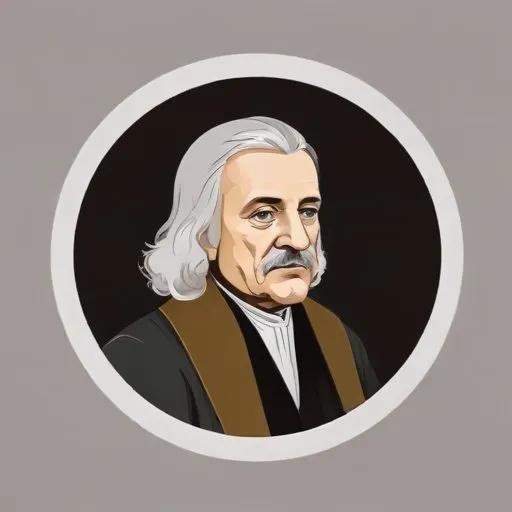
A 17th-century astronomer and politician who cataloged over 1,500 stars and invented several astronomical instruments, including the first refracting telescope. He's also credited with discovering four moons of Saturn.
Johannes Hevelius, a Polish astronomer and councillor of Danzig, is renowned for his groundbreaking contributions to the field of astronomy, earning him the esteemed title of "Father of Lunar Topography". His meticulous observations and descriptions of the Moon's surface paved the way for modern lunar cartography, and his discovery of ten new constellations has left an indelible mark on the annals of astronomy.
Born on January 28, 1611, in Danzig, Polish-Lithuanian Commonwealth, Hevelius was the son of Abraham Hewelke and Kordula Hecker, both German-speaking Lutherans of Bohemian origin. His early life was marked by a fascination with the stars, and he was taught by Peter Crüger, a prominent educator of the time. Hevelius went on to study jurisprudence at Leiden, and later traveled to England and France, where he encountered luminaries such as Pierre Gassendi, Marin Mersenne, and Athanasius Kircher.
Hevelius' most significant contributions came in the field of lunar topography. His observations, conducted using a combination of telescopes and quadrants, allowed him to create detailed maps of the Moon's surface. He identified and named several lunar features, including the Mountains of the Moon, and his work in this area has been widely recognized as foundational to the field. In addition to his lunar research, Hevelius also discovered ten new constellations, seven of which are still recognized by astronomers today.
These constellations, though not as well-known as some of their more prominent counterparts, have played a significant role in shaping our understanding of the night sky. Hevelius' descriptions of these constellations, published in his magnum opus, Selenographia, have been instrumental in guiding astronomers and stargazers alike.
Hevelius' contributions to astronomy have been far-reaching and profound. His work laid the groundwork for future lunar research, and his constellations have become an integral part of the astronomical canon. In addition to his scientific achievements, Hevelius served as a councillor and mayor of Danzig, and was a prominent figure in the brewing industry, producing the famous Jopen beer.
In 1635, Hevelius married Katharine Rebeschke, a neighbor two years his junior, and went on to lead the beer-brewing guild in Danzig. Throughout his life, Hevelius was driven by a passion for discovery and a commitment to sharing his knowledge with the world.
"The Moon is a faithful observer of the universe, and its surface bears witness to the secrets of the cosmos."
This quote, taken from Hevelius' Selenographia, serves as a testament to his enduring fascination with the Moon and its mysteries.
Hevelius' work was not without its challenges. Living during a time of great scientific upheaval, he faced criticism and skepticism from his contemporaries. Despite these obstacles, he persevered, driven by a passion for discovery and a commitment to advancing human knowledge. Today, Hevelius is remembered as a pioneer in the field of astronomy, and his contributions continue to inspire new generations of scientists and stargazers alike.
Born in 1473
A Renaissance-era mathematician and astronomer who proposed the heliocentric model, where the Sun is at the center of our solar system, revolutionizing our understanding of the universe.
Born in 1546
A 16th-century astronomer who made precise measurements of the stars and planets, laying the foundation for modern astronomy. His data helped Kepler discover planetary orbits.
Born in 1564
Pioneering astronomer, physicist, and mathematician who played a major role in the Scientific Revolution, making key discoveries that challenged Aristotelian views and laid the foundation for modern science.
Born in 1571
A 17th-century trailblazer who discovered the three laws of planetary motion, revolutionizing our understanding of the solar system. He's also credited with being a pioneer in the field of astrology.
Born in 1629
A 17th-century polymath who made groundbreaking contributions to optics, probability theory, and astronomy, including the discovery of Saturn's rings and the largest moon, Titan.
Born in 1644
Danish astronomer and instrument maker who made the first quantitative measurements of the speed of light and contributed to the development of telescopes and other astronomical instruments.
Born in 1656
Predicted celestial events, including the return of a comet that bears his name, and made significant contributions to navigation, astronomy, and mathematics.
