


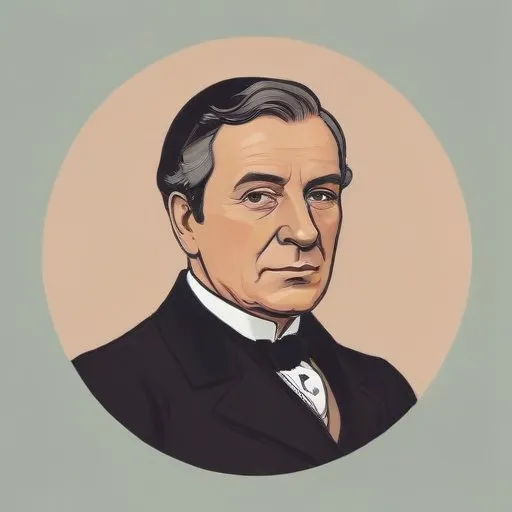
A renowned British jurist and politician who served as a Lord Justice of Appeal and presided over several high-profile inquiries, including the Titanic disaster investigation. He's known for his fairness and meticulous approach to justice.
John Bigham, 1st Viscount Mersey, is indelibly etched in the annals of history as the esteemed jurist and politician who led the official Board of Trade inquiries into the sinking of some of the most infamous maritime disasters of the early 20th century, including the RMS Titanic, RMS Lusitania, and RMS Empress of Ireland, as well as the Falaba, which spawned the Thrasher incident.
Through his meticulous and exhaustive investigations, Mersey brought to light crucial insights into the circumstances surrounding these tragedies, shaping the course of maritime safety regulations and cementing his reputation as a stalwart champion of accountability and justice.
Born on August 3, 1840, in Liverpool, Mersey was the second son of a prosperous merchant, John Bigham, and his wife, Helen (née East). He received his early education at the Liverpool Institute High School for Boys, followed by studies in law at the University of London, although he left without completing his degree.
Undeterred, Mersey continued his education in Berlin and Paris, eventually being called to the bar in 1870 by the Middle Temple. His early forays into commercial law practice in and around Liverpool laid the foundation for his future success.
In 1883, Mersey was named a Queen's Counsel, a testament to his burgeoning reputation as a skilled and erudite commercial lawyer. His practice flourished, and by the late 1890s, he had become one of the most sought-after and affluent lawyers of his circle.
In 1897, Mersey's acumen and expertise earned him a judgeship on the Queen's Bench, where he continued to specialize in business law. His subsequent appointment to the Board of Trade inquiries solidified his position as a preeminent authority on maritime law and regulations.
Mersey's personal life was marked by a happy marriage to Georgina Sarah Rogers, with whom he had three sons. His eldest son, Charles Clive Bigham, would go on to succeed him as the 2nd Viscount Mersey.
Throughout his life, Mersey remained committed to public service, using his position to advocate for improved safety standards and accountability in the maritime industry. His tireless efforts have had a lasting impact on the development of maritime law and regulations, ensuring that the lessons learned from those tragic events are never forgotten.
Despite his many achievements, Mersey's tenure as inquiry chairman was not without controversy. Criticisms of his handling of the Titanic inquiry, in particular, have been levied, with some accusing him of being overly deferential to the shipping industry and neglecting the plight of the victims' families.
However, it is essential to contextualize these criticisms within the broader societal and political landscape of the time. Mersey's commitment to upholding the rule of law and promoting maritime safety, despite the prevailing attitudes and interests, remains an enduring testament to his character and dedication to justice.
In concluding, John Bigham, 1st Viscount Mersey, leaves behind a lasting legacy that transcends the boundaries of law, politics, and maritime history. His unwavering commitment to the pursuit of truth, accountability, and justice has inspired generations of legal minds, policymakers, and maritime professionals.
As we reflect on his remarkable life and achievements, we are reminded of the significance of his work in shaping the course of maritime safety and regulations, and the importance of honoring his memory by continuing to strive for a safer, more just, and more compassionate world.
Born in 1863
A Welsh lawyer and politician who served as Prime Minister of the United Kingdom, leading the country through World War I and introducing key social reforms. He's known for his charismatic leadership and progressive policies.
Born in 1852
A British Prime Minister who led the country through the early years of World War I, known for his role in shaping the country's war effort and introducing reforms like women's suffrage.
Born in 1858
A Canadian-Scottish banker and politician who served as Prime Minister of the United Kingdom during World War I, known for his leadership during wartime and his role in shaping British politics.
Born in 1871
Prolific writer of historical novels and adventure stories, also a talented landscape painter.
Born in 1866
A Scottish journalist and politician who served as the first Labour Party Prime Minister of the United Kingdom, leading the country through significant economic and social reforms. He is also known for his efforts to maintain peace in Europe during the interwar period.
Born in 1867
A conservative leader who served as Prime Minister three times, known for his role in navigating Britain through economic crises and advocating for imperial protectionism.
